

Introduction
Quantum computing has become one of the most debated technological frontiers of our time. It is touted by some as a transformative leap that will reshape industries ranging from cryptography to medicine, and by others as an overhyped promise that remains, for now, largely confined to research labs. At the heart of the debate lies a fundamental question: Are quantum computers genuinely on the cusp of revolutionizing computation, or are they an exuberant mirage propelled by speculative expectations and marketing banners? To answer this, we must first understand what quantum computing is, how it differs from classical computing, and why it has ignited both excitement and skepticism.
In a classical computer, information is encoded in bits that assume a value of either 0 or 1. Quantum computers, by contrast, use quantum bits or qubits that can exist in superpositions of states — meaning they can represent 0 and 1 simultaneously. This, in conjunction with quantum phenomena like entanglement and interference, theoretically allows quantum systems to perform certain classes of computations exponentially faster than classical computers. But the transition from theoretical promise to practical utility is fraught with challenges, both technical and conceptual.
This essay explores the development divide in quantum technologies, the opportunities and challenges they present, strategic considerations for balanced progress, relevant policy frameworks and historical context, illustrative case studies, and well-founded recommendations for policy prioritization. Ultimately, we will reflect on whether quantum computing is enduring breakthrough technology or a technological bubble awaiting correction.
The Realistic Path To Quantum Computing: Separating Hype From Reality

The Realistic Path to Quantum Computing: Separating Hype from Reality
getty
If there’s one technology that has captured the imagination of futurists and tech enthusiasts as much as generative AI, it’s quantum computing. The buzz is deafening – promises of breakthroughs in encryption, pharmaceuticals, and financial modeling fill headlines. We’re told that quantum will change everything, making today’s supercomputers look like abacuses. But before enterprises start reshaping their strategies around an imminent quantum revolution, let’s take a hard look at where this technology actually stands today – and what it will take to make it truly transformative.
Quantum computing: More than Sci-Fi, but not quite ready for prime time
Quantum computing isn’t just a faster version of what we already have – it’s a complete paradigm shift. Unlike classical computers that process bits as either 0s or 1s, quantum computers use qubits, which can exist in multiple states simultaneously. This property, known as superposition, theoretically allows quantum computers to perform complex calculations at speeds that classical systems simply can’t match.
For IT service providers, the implications are massive. Quantum computing has the potential to crack problems that were previously considered impossible – think real-time risk modeling, hyper-efficient supply chains, and unbreakable cryptographic security. But before enterprises rush to invest, they need a realistic understanding of where we are on the quantum timeline and what’s actually achievable in the next few years.
The major roadblocks holding quantum back
Despite the hype, quantum computing is not an overnight sensation. Major technical challenges still stand in the way of widespread enterprise adoption. Let’s break down the most significant hurdles:
1. Qubit stability: The fragility problem
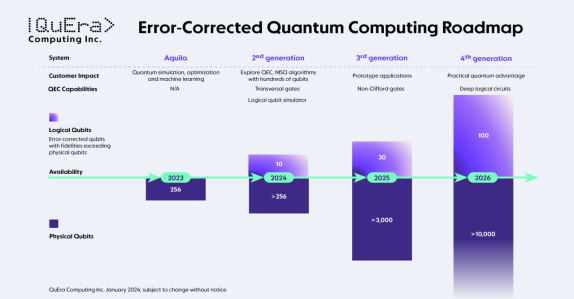
Qubits are incredibly fragile. Even the slightest environmental disturbance – like a tiny fluctuation in temperature – can cause them to lose coherence, leading to computational errors. Researchers are working on topologically protected qubits to improve stability, but we’re still five to seven years away from reliable, large-scale systems.
2. Error correction: The Achilles heel
In classical computing, error correction is straightforward. In quantum computing, it’s exponentially more complex. Right now, quantum error rates are significantly higher than classical ones, making large-scale computation impractical. Advances in error correction are progressing, but we likely won’t see scalable, reliable systems for at least another five years.
3. Scalability: More qubits, more problems
Scaling quantum computers isn’t as simple as adding more qubits. Unlike classical chips that can be stacked and scaled efficiently, quantum systems require significant improvements in architecture and quantum interconnects. We may be a decade away from quantum systems that can reliably tackle enterprise-scale problems.
Quantum’s first real-world applications are emerging
Even with these obstacles, quantum computing isn’t just an academic exercise—it’s starting to show real promise. Several industries are already experimenting with quantum-enhanced solutions:
Cybersecurity and Cryptography – Quantum Key Distribution (QKD) is showing potential in secure communications, with companies like ID Quantique leading the charge.
Pharmaceuticals – Firms like Biogen are leveraging quantum algorithms to accelerate drug discovery, particularly for diseases like Alzheimer’s.
Automotive and Mobility – Volkswagen and D-Wave are exploring quantum computing to optimize EV battery materials and improve traffic flow modeling.
Financial Services – JPMorgan Chase and Goldman Sachs are developing quantum models for portfolio optimization and risk analysis.
These use cases demonstrate that while large-scale quantum adoption is still years away, selective applications are already proving valuable in highly specialized domains.
Where is quantum headed?
The race toward quantum supremacy – the point at which quantum computers outperform classical computers for specific tasks – is in full swing. But what will determine when (and how) enterprises can start integrating quantum into their operations?
1. The infrastructure battle
Quantum computing requires an entirely new infrastructure – something only a handful of companies, such as IBM, Google, and Rigetti, are actively developing. This raises concerns about monopolization. Will quantum computing power be centralized in the hands of a few dominant players, limiting enterprise access and innovation?
2. Hybrid computing is the future
Quantum computing won’t replace classical systems overnight. Instead, we’ll see hybrid environments where quantum and classical computers work together, with quantum handling complex computations while classical systems manage everything else. Enterprises should prepare for this hybrid approach rather than betting on a full quantum transition in the near future.
3. Government and private investment will be key
Quantum computing requires significant investment, and governments are stepping up. The U.S. National Quantum Initiative, along with similar efforts in Europe and China, is pouring billions into quantum R&D. Meanwhile, tech giants and venture capitalists continue to fund startups tackling quantum hardware and algorithms. Enterprises should watch where this investment flows – because it will shape when and how they can leverage quantum technology.
4. The workforce challenge
Quantum computing expertise is scarce. Organizations that begin investing in a quantum-ready talent pipeline now – through upskilling, partnerships, and research collaborations – will have a competitive edge once quantum computing becomes mainstream.
What should enterprises do today?
Given the challenges and the long road ahead, what should businesses be doing now to prepare for quantum computing’s future impact? Here are some strategic steps:
Develop a quantum roadmap – Companies should assess how quantum computing could impact their industry and start building a roadmap for adoption. This doesn’t mean overhauling everything, but identifying key areas where quantum could create a competitive advantage in the next decade.
Invest in research and partnerships – Collaboration with academic institutions, quantum startups, and industry groups can provide early exposure to quantum capabilities.
Monitor quantum readiness in cybersecurity – Quantum will eventually disrupt encryption standards. Enterprises should start preparing for quantum-resistant cryptographic solutions now.
Experiment in a low-risk environment – Companies can begin running quantum simulations and proof-of-concept projects through cloud-based quantum services like IBM Quantum and AWS Braket. This allows them to gain familiarity with the technology without heavy upfront investment.
Build a quantum-skilled workforce – Hiring quantum talent may be difficult now, but organizations can start by upskilling existing teams in quantum-related areas like linear algebra, probability, and quantum algorithms.
Final thought: The future belongs to the quantum-prepared
Quantum computing isn’t a passing trend – it’s an inevitable evolution of computational technology. But broad adoption is still several years away. Enterprises that wait for quantum to reach full maturity before taking action will find themselves playing catch-up in a radically transformed digital economy.
I. Development Divide
To evaluate whether quantum computing is revolutionary or hyperbolic, we must examine the current landscape of quantum technology. The development trajectory of quantum computing reveals a distinction between scientific progress and commercial readiness, creating what can be termed a development divide.
Scientific and Technical Progress
Quantum computing research has advanced rapidly over the past two decades. Starting with theoretical frameworks such as Shor’s algorithm for integer factorization and Grover’s algorithm for unstructured search, researchers outlined tasks where quantum machines could outperform classical ones. These algorithms demonstrated, at least mathematically, that quantum advantage was possible — meaning quantum computers could, in principle, solve specific problems more efficiently than classical computers.
In practical implementations, we have seen the construction of prototype quantum processors using superconducting qubits, trapped ions, photonic systems, and other technologies. Companies and research institutions around the world have built machines with tens to, in some cases, dozens of qubits. Landmarks such as “quantum supremacy” experiments — where a quantum processor performed a specific calculation faster than the world’s fastest classical supercomputer — have captured international attention.
Commercial Realities and Limitations
Despite this progress, we have yet to see widespread real-world applications that definitively outperform classical approaches on problems of practical interest. Many current quantum devices are noisy, error-prone, and too small in scale to deliver useful computations beyond certain benchmarks. This operational state is often termed Noisy Intermediate-Scale Quantum (NISQ) technology.
This divide — between promising research breakthroughs and viable, large-scale quantum machines — fuels skepticism. Enthusiasts point to advances in error correction, increasing qubit counts, and expanding industry investment as evidence that practical quantum computing is near. Critics warn that the technical barriers to scalable, fault-tolerant quantum computing are immense and may take decades to overcome, if they are overcome at all.
II. Opportunities and Challenges
Quantum computing presents both extraordinary opportunities and formidable challenges. Appreciating both is key to differentiating between meaningful optimism and uncritical hype.
Opportunities
- Computational Speed and Efficiency
- Quantum algorithms could revolutionize computations such as large integer factorization, optimization problems, and simulation of quantum systems. This has major implications for cryptography, material science, and logistics.
- Drug Discovery and Material Science
- Simulating molecular and atomic interactions with quantum fidelity could accelerate the discovery of new drugs, advanced materials, and catalysts, addressing challenges in health care, energy, and industrial chemistry.
- Optimization and Machine Learning
- Many real-world problems — from supply chain optimization to portfolio management — involve complex optimization. Quantum approaches promise speedups for certain classes of these problems, potentially redefining operations research and AI.
- Cryptography and Security
- Current cryptographic protocols (e.g., RSA, ECC) rely on the difficulty of factoring large numbers or discrete logarithms. Quantum algorithms threaten these foundations, motivating new classes of quantum-resistant cryptography — a dual challenge and opportunity.
Challenges
- Error Correction and Decoherence
- Quantum computers are highly susceptible to environmental noise and errors. Creating fault-tolerant quantum systems with millions of reliable qubits is a massive engineering challenge.
- Scalability
- Increasing qubit counts and connecting them in stable, controllable ways remains technically demanding. Many physical implementations struggle with coherence times, control precision, and connectivity.
- Software and Algorithms
- Writing efficient quantum algorithms requires new paradigms and expertise. Unlike classical computing, where software ecosystems are mature, quantum software stacks are nascent, with limited tooling and talent.
- Economic Viability
- The costs of developing, maintaining, and scaling quantum hardware are high. Whether commercial models can justify these investments remains an open question.
- Ethical and Security Risks
- Once functional, large-scale quantum computers could break widely used encryption, undermining digital security. Ethical frameworks must anticipate misuse alongside benefits.
III. Strategies for Balanced Progress
Rather than accelerating blindly toward a quantum future or dismissing the technology as overhyped, stakeholders should adopt strategies that balance ambition with realism.
Invest in Fundamental Research
Sustained funding in quantum physics, materials science, and engineering is necessary. Governments, universities, and industry labs should support long-term research that prioritizes open knowledge, reproducibility, and foundational breakthroughs.
Build Hybrid Systems
Instead of focusing solely on fault-tolerant quantum machines — which may be decades away — researchers can develop quantum-classical hybrid systems. These systems combine classical processors with quantum co-processors to tackle specific subproblems where quantum advantage is likely in the near term.
Develop Robust Software Ecosystems
Investing in quantum programming languages, compilers, and algorithms will expand the talent pool and ecosystem. Collaboration between academic researchers and software developers can accelerate practical software toolchains.
Promote Open Benchmarking and Standards
Standardized benchmarking and transparent reporting will help distinguish genuine progress from inflated claims. Open protocols for reporting qubit quality, error rates, and performance metrics can combat hype and clarify expectations.
Education and Workforce Development
A skilled workforce is crucial. Universities and online educational platforms should expand offerings in quantum information science, engineering, and ethics, ensuring a pipeline of professionals equipped to innovate responsibly.
IV. Policy Frameworks and Historical Context
Understanding quantum computing’s potential impact requires situating it within broader innovation policy and technological history.
Historical Parallels
Technological revolutions often undergo phases of hype, disillusionment, and eventual maturity. The development of the semiconductor industry, the internet, and artificial intelligence all experienced early optimism, periods of overpromising and underdelivery, and later substantive impact.
For example, early AI research in the 1950s–1970s saw predictions of human-like intelligence within decades. When these expectations fell short, funding dried up in periods termed AI winters. Only later, with advances in algorithms and hardware, did AI achieve transformative impact. This historical arc suggests that early exuberance is not unusual — but also that practical impact can follow a long incubation period.
Policy Considerations
Public policy plays a critical role in shaping the trajectory of quantum technologies:
Funding and Incentives
Strategic government investments can de-risk early research and attract talent. Public funding can fill gaps that private investors avoid due to long time horizons.
Standards and Regulation
Governments and international bodies should participate in setting standards for quantum hardware interoperability, software protocols, and security practices.
Security and Cryptography
Policy frameworks must support the transition to quantum-resistant cryptographic standards to protect digital infrastructure before large-scale quantum computers are operational.
International Collaboration
Quantum research often transcends national boundaries. Cooperative frameworks can accelerate science while managing strategic competition.
Ethics and Public Trust
Transparent governance and ethical oversight can mitigate misuse. Public engagement is essential in shaping policies that reflect societal values.
These policy frameworks — when grounded in evidence and balanced expectations — can help harness the benefits of quantum computing while mitigating risks and minimizing wasted resources.
V. Case Studies in Integrated Development
Concrete examples from research initiatives, collaborations, and commercial projects illustrate how quantum computing is evolving in practice.
Case Study 1: National Quantum Initiatives
Several countries have launched national quantum programs to drive research and build infrastructure. These initiatives often combine government funding, academic research centers, and industry partnerships. For example, national consortia might fund clean-room facilities, offer grants for quantum algorithm research, and create innovation hubs that connect startups with larger labs.
Such programs help distribute risk, coordinate efforts, and prevent redundant research, embodying balanced approaches that integrate scientific exploration with strategic planning.
Case Study 2: Consortium-Led Hardware Development
Industry consortia — grouping tech companies, hardware manufacturers, and academic labs — pursue collaborative development of quantum hardware. By pooling expertise and sharing results, these groups advance engineering solutions to error correction and qubit control, accelerating technical progress beyond what isolated entities can achieve.
Case Study 3: Hybrid Computing in Practice
Some organizations are already experimenting with hybrid quantum-classical approaches for optimization problems. For example, logistics companies have tested quantum annealing systems to optimize routing, and financial firms have piloted quantum algorithms for portfolio analysis.
These early applications, while not yet definitive breakthroughs, demonstrate how quantum resources can complement classical computing and deliver incremental value within existing computational frameworks.
VI. Recommendations for Policy Prioritization
Based on the opportunities and challenges identified above, policymakers should prioritize actions that responsibly accelerate quantum innovation without succumbing to hype:
Support Long-Term Fundamental Research
Increase funding for foundational quantum science across universities and national laboratories.
Establish Clear Progress Metrics
Develop and adopt benchmarks for performance, error rates, and usable qubit counts to enable transparent assessment of progress.
Invest in Workforce Development
Expand educational programs in quantum science, engineering, and ethics to prepare a diverse and skilled workforce.
Promote Public-Private Partnerships
Encourage collaboration between industry, academia, and government to bridge fundamental research and commercialization pathways.
Advance Quantum-Resistant Security Standards
Proactively support the transition to cryptographic standards resilient to quantum attacks, protecting critical infrastructure before threats materialize.
Foster International Cooperation
Engage in bilateral and multilateral partnerships to share knowledge, harmonize standards, and jointly address strategic risks.
Ensure Ethical Oversight
Develop frameworks for ethical evaluation of quantum technologies, including human rights implications and socioeconomic impacts.
Facilitate Access to Quantum Resources
Support cloud-based quantum computing access for researchers and startups, democratizing experimentation and innovation.
By prioritizing these policies, governments and institutions can strengthen the ecosystem and direct efforts toward tangible opportunities rather than speculative claims.
Conclusion
Quantum computing sits at the intersection of high promise and real uncertainty. Its potential to revolutionize computation — especially in optimization, simulation, and cryptography — is grounded in rigorous theory and emerging experiments. Yet the road to large-scale, fault-tolerant quantum computers is long, complex, and technically demanding. Much of the current excitement mixes genuine scientific milestones with aspirational projections that may overstate near-term impact.
The question of whether quantum computing is hype or a revolutionary breakthrough does not admit a binary answer. It is both: a field propelled by visionary ideas and significant early results, yet still grappling with deep technical and economic challenges. The prudent path forward embraces the opportunities quantum computing offers while tempering expectations with an honest appraisal of the hurdles that remain.
Balanced progress will require thoughtful investments in research, strategic policy frameworks, sustained international collaboration, and a commitment to education and ethical governance. If these conditions are met, quantum computing may indeed fulfill its promise as one of the transformative technologies of the 21st century — not as an instantaneous revolution, but as a gradual convergence of scientific ingenuity and practical realization.