
Introduction
World War I (1914–1918) stands as one of the most transformative events in modern European history. What began as a regional conflict triggered by the assassination of Archduke Franz Ferdinand of Austria-Hungary rapidly escalated into a global war involving major European powers and their overseas empires. The war resulted in unprecedented human loss, economic devastation, and political upheaval. More importantly, it fundamentally reshaped the political, social, and territorial landscape of Europe. Long-standing empires collapsed, new nation-states emerged, and old power structures were dismantled, giving rise to new political ideologies and conflicts that would shape the twentieth century.
The reshaping of Europe after World War I was not merely a redrawing of borders but a profound transformation involving political systems, economic conditions, and social relations. The peace settlements attempted to establish a stable and balanced Europe but often created deep divisions and unresolved tensions. This essay examines how World War I reshaped Europe by exploring its historical context, the development divide that emerged after the war, the opportunities and challenges faced by postwar Europe, strategies for balanced reconstruction, policy frameworks implemented through peace treaties, case studies of integrated development in selected regions, and recommendations for policy prioritization. Through this analysis, the essay highlights both the achievements and failures of the postwar order and their lasting consequences.
Historical Context
Before World War I, Europe was dominated by powerful multinational empires, including the Austro-Hungarian Empire, the Ottoman Empire, the Russian Empire, and the German Empire. These empires maintained relative stability through complex alliances, imperial authority, and military strength. However, beneath this stability lay deep-seated tensions fueled by nationalism, imperial rivalry, militarism, and unresolved ethnic conflicts. The Balkan region, in particular, was a hotspot of nationalist movements that threatened imperial control.
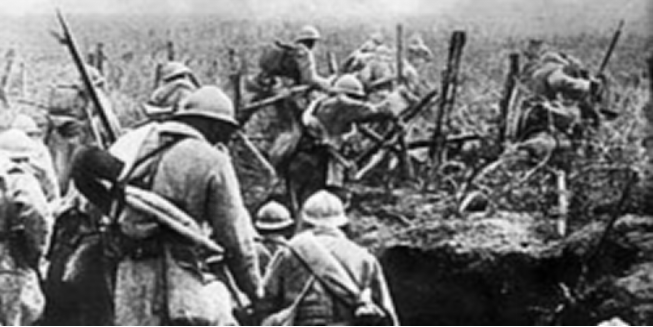
The outbreak of World War I exposed and intensified these underlying tensions. Industrialized warfare, trench battles, and total mobilization of societies marked a new era of conflict. By the war’s end in 1918, Europe had suffered massive casualties, widespread destruction of infrastructure, and economic collapse. Monarchies fell, revolutionary movements gained momentum, and faith in traditional political institutions weakened. The war thus set the stage for a dramatic reshaping of Europe’s political and territorial order.
How World War 1 Reshaped The Course of Europe
With the assassination of Archduke Franz Ferdinand of Austria-Hungary in Sarajevo, World War 1 rapidly engulfed the continent of Europe.
by Mike Haskew
On June 28, 1914, Archduke Franz Ferdinand of Austria-Hungary and his wife, Sophie, Duchess of Hohenberg, visited the city of Sarajevo and were assassinated by Gavrilo Princip, a 20-year-old Yugoslav nationalist. The assassinations triggered World War 1, which broke out a month later when Austria-Hungary declared war on Serbia. A series of alliances resulted in a rapid expansion of hostilities as Russia honored its treaty obligation with Serbia and declared war. Germany entered the war on the side of Austria-Hungary, and France and Great Britain soon joined the conflict as allies of Russia and Serbia.
The Triple Entente vs. the Central Powers
As the principal Allied Powers, also known as the Triple Entente, including Great Britain, France, and Russia, opposed the Central Powers, primarily Germany, Austria-Hungary, and later the Ottoman Empire, the conflict developed in to a series of devastating battles on land, sea, and air and escalated to a global scale. In the East, Germany’s great victory at Tannenberg in 1914 helped to spark revolution in Russia and took that nation out of the war in 1917 with the the separate peace of the Treaty of Brest-Litovsk. On the Western Front, great battles were fought along the Marne River, and at such locations as Ypres, Amiens, the Somme, and in Flanders. The war on the Western Front settled down to a contest of attrition, and the agony of trench warfare proved costly to both sides.
The aftermath of World War II witnessed a profound transformation in the geopolitical landscape of Europe. As nations emerged from the ruins of war, cartographers diligently mapped out the contours of a new reality. In this exploration, we delve into the intricacies of the Europe map after World War II, examining the changes, redrawing of borders, and the reshaping of alliances reflected in the world of post-war cartography.
The World War II Maps:
To comprehend the Europe map post-World War II, it is crucial to first revisit the maps that chronicled the tumultuous years of the war itself. These World War II maps serve as a historical compass, guiding us through the ever-shifting fronts, battles, and alliances that defined an era of unprecedented global conflict.
The map of countries involved in World War II was a mosaic of alliances and conflicts. Axis powers, led by Nazi Germany, Imperial Japan, and Fascist Italy, clashed with the Allied forces, consisting of the United States, the Soviet Union, the United Kingdom, and a coalition of other nations. The theatres of war spanned continents, from the Pacific islands to the Eastern Front in Europe.
European World War II Map:
Zooming into the European theater, a European World War II map vividly illustrates the intensity of the conflict. The map outlines the Axis-controlled territories, the advancing Allied forces, and the pivotal battles that shaped the outcome of the war. Key landmarks, cities, and strategic points are marked, providing a visual narrative of the ebb and flow of the conflict.
One notable feature on the European World War II map is the division of Germany. The nation, once a powerful force in the heart of Europe, found itself torn apart by the Allied forces from the West and the Soviet forces from the East. This division would set the stage for the subsequent geopolitical developments in the post-war era.
Post-World War II Redrawings:
As the dust settled and the world sought to rebuild, cartographers faced the daunting task of redrawing the maps to reflect the new realities on the ground. The end of World War II marked the beginning of a new era, and the European map underwent significant changes. The most iconic transformation was the division of Germany into East and West Germany.
The Cold War rivalry between the United States and the Soviet Union shaped the political and territorial landscape of post-war Europe. The Iron Curtain, a term coined by Winston Churchill, symbolized the ideological divide between the communist Eastern Bloc, led by the Soviet Union, and the democratic Western Bloc, led by the United States.
The European map after World War II displayed the emergence of satellite states aligned with either the Eastern or Western Bloc. Countries such as Poland, Hungary, Czechoslovakia, and East Germany became part of the Soviet sphere of influence, while nations like France, the United Kingdom, and West Germany aligned with the Western Bloc.
The Marshall Plan, an American initiative to aid the economic recovery of Western European countries, played a pivotal role in shaping the post-war map. The infusion of financial assistance facilitated the rebuilding of war-torn nations and strengthened the bonds between Western European countries and the United States.
Reconstruction and Reconciliation:
The post-World War II period was not only about redrawing maps but also about rebuilding nations and fostering reconciliation. The European Recovery, more commonly known as the Marshall Plan, aimed to revive the war-ravaged economies of Western Europe. The initiative not only contributed to economic reconstruction but also sowed the seeds of cooperation and unity among European nations.
The formation of the European Coal and Steel Community (ECSC) in 1951 marked a significant step toward European integration. Belgium, France, Italy, Luxembourg, the Netherlands, and West Germany joined forces to regulate their coal and steel industries, laying the groundwork for the European Union (EU) in the decades to come.
The European map after World War II began to evolve beyond political boundaries. Economic cooperation and shared resources fostered a sense of interdependence among European nations, leading to a desire for closer collaboration. The Treaties of Rome in 1957 established the European Economic Community (EEC), further advancing the vision of a united and prosperous Europe.
The Fall of the Iron Curtain:
While Western Europe experienced economic integration and collaboration, the Eastern Bloc remained under Soviet influence. However, the tides of change began to sweep through Eastern Europe in the late 1980s. The policies of perestroika and glasnost introduced by Soviet leader Mikhail Gorbachev contributed to a thaw in relations and triggered a series of events that would reshape the European map once again.
The fall of the Berlin Wall in 1989 symbolized the end of the Cold War division in Germany. East and West Germany reunified, marking a historic moment in European history. The reunification of Germany had profound implications for the European map, as it signaled the dismantling of the Iron Curtain and the gradual integration of Eastern European nations into the broader European community.
The Dissolution of Yugoslavia:
As the Cold War came to an end, the dissolution of the Eastern Bloc was not the only challenge facing Europe. The disintegration of Yugoslavia in the early 1990s added a complex layer to the post-World War II European map. Ethnic and nationalist tensions erupted into violent conflicts, leading to the creation of new independent states.
The maps of the Balkans underwent radical changes as Slovenia, Croatia, Bosnia and Herzegovina, Macedonia, and later Kosovo emerged as independent nations. The redrawing of borders and the establishment of new states highlighted the ongoing challenges of managing diversity and fostering stability in the post-Cold War era.
The European Phase of World War I: Stalemate and Suffering
The European phase of World War I, lasting from 1914 to 1917, was marked by intense and grueling battles, as well as a deepening sense of hopelessness. As the war escalated, Europe became the epicenter of a brutal conflict that saw countries battle not only for territory and power but for survival. The German forces initially made rapid advances, but the tide soon turned, leading to a prolonged stalemate that cost millions of lives. The resulting trench warfare, especially along the Western Front in France and Belgium, created a horrific environment where soldiers were subjected to unimaginable hardships. But the devastation wasn’t confined to just these areas—battles on the Eastern and Balkan fronts also contributed to the immense suffering of both soldiers and civilians alike. In this blog, we will explore the European phase of World War I, focusing on the stalemate, the suffering, and the far-reaching consequences of the conflict.
The early stages of the European phase: Rapid advances and a false sense of hope
When World War I broke out in 1914, the European powers quickly mobilized their forces, believing the conflict would be short and decisive. Germany, with its powerful army, had a well-thought-out plan—the Schlieffen Plan—aimed at defeating France before turning to fight Russia. The plan relied on a rapid invasion of France through Belgium, bypassing the heavily fortified French-German border. Initially, the German forces made impressive progress, quickly advancing into Belgium and northern France. This gave them a false sense of optimism that the war would be over soon.
However, the German advances were met with stiff resistance from the French and British forces, aided by the Belgian military. The initial successes of Germany were countered by the failure of the Schlieffen Plan, which eventually led to a slowing down of the advance and a bloody standoff. The German army was now faced with the difficult task of holding on to the territories it had gained, but the situation on the Western Front was about to take a dark turn.
The shift to a stalemate: Trench warfare on the Western Front
The most devastating and iconic aspect of World War I was the introduction of trench warfare, especially along the Western Front, which stretched from the English Channel in the north to Switzerland in the south. The once-promising rapid advances were replaced by entrenched positions, where both sides faced each other across no man’s land—an area littered with barbed wire, shell craters, and death.
By 1915, the war had transformed into a brutal stalemate. The Germans, the French, and the British were now stuck in a deadly gridlock, unable to make significant advances. The use of machine guns, artillery, and new weapons such as poison gas made it incredibly difficult for either side to gain ground. In fact, some of the most infamous battles, such as the Battle of the Somme (1916) and the Battle of Verdun (1916), epitomized this horrific stalemate. These battles lasted for months and resulted in massive casualties on both sides, with little to show for the sacrifice.
The legacy of the European phase of World War I
The European phase of World War I, with its stalemate, trench warfare, and staggering casualties, had a lasting impact on Europe and the world. The war reshaped the political landscape, with the downfall of empires such as the Austro-Hungarian, Ottoman, and Russian Empires. The Treaty of Versailles, which brought an end to the war in 1919, imposed harsh penalties on Germany, sowing the seeds of resentment that would later contribute to the rise of Nazi Germany and the outbreak of World War II.
In the aftermath of the war, the world also saw the rise of new ideologies and political movements, including communism and fascism, which would shape the course of history in the 20th century. The war’s impact on European society, culture, and politics cannot be overstated—it was a turning point that forever altered the trajectory of the continent and the world.
How World War I Redrew Europe’s Borders
This past week, one hundred years ago, World War I began as Austria-Hungary declared war on Serbia and drew the other nations and empires of Europe into the conflict. The war drastically changed the course of the twentieth century, and the peace that was negotiated at the end unwittingly set the stage for World War II just two decades later. In particular, it radically changed the borders of Europe, such that the map of Europe in 1919, after the Treaty of Versailles, was vastly different from the map in 1914.
The Economist recently published an article commemorating the anniversary of the start of the war, including a fascinating graphic that lets you “slide” between the maps and see just how each corner of the continent changed from the start of the war until the peace treaties had been signed. You can check out the slider for yourself here: http://infographics.economist.com/2014/1914-19Swiper/1914.19.html
I took screenshots from the Economist post and have reproduced them below:
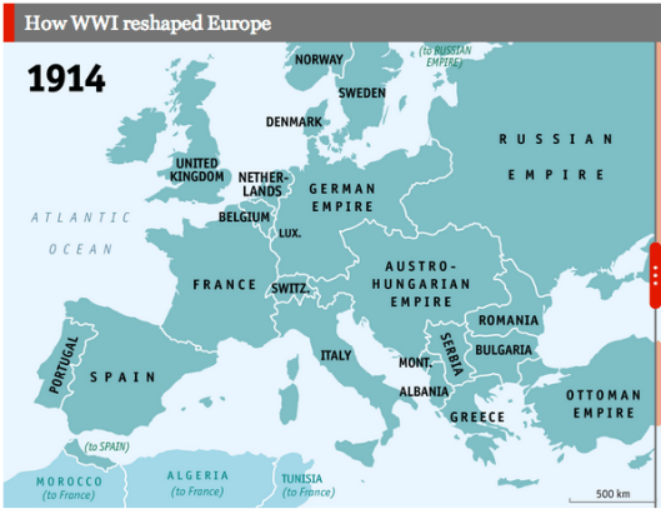
Via the Economist (http://www.economist.com/news/international/21610243-redrawing-map)
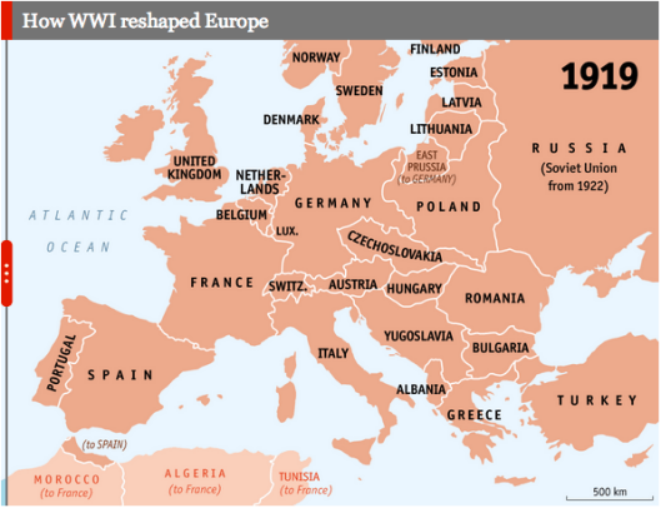
Via the Economist (http://www.economist.com/news/international/21610243-redrawing-map)
Border changes over the space of those five years were both great and small. France and Denmark gained some territory at the expense of Germany. The Austro-Hungarian Empire disappeared completely, succeeded by various smaller states (some of which would break up further later on in the century). States which had previously not been independent, such as Poland, were able to reassert their independence.
The map shows how Germany in particular was punished by the allied powers at the end of the war. What it does not show, of course, is the level of economic reparations levied against Germany, and the level of wounded pride the nation suffered, which laid the seeds for the rise of Hitler in the 1930s.
I. Development Divide
One of the most significant consequences of World War I was the emergence of a sharp development divide across Europe. Western European countries such as Britain and France, although severely damaged, retained their political independence and colonial resources. In contrast, Central and Eastern Europe experienced far greater instability due to the collapse of empires and the creation of new states with limited economic capacity.
The dissolution of the Austro-Hungarian, Ottoman, and Russian empires resulted in the formation of new nations such as Poland, Czechoslovakia, Yugoslavia, and Hungary. While these states fulfilled nationalist aspirations, they often inherited weak economies, ethnically mixed populations, and fragile political institutions. Borders drawn by the peace settlements frequently ignored ethnic realities, leading to minority problems and internal divisions.
This development divide was further deepened by unequal access to resources, capital, and markets. Western Europe began rebuilding through industrial recovery and financial systems, while Eastern Europe struggled with agrarian economies, inflation, and political instability. The uneven development across Europe created long-term disparities that undermined regional cohesion and stability.
II. Opportunities and Challenges
The postwar period presented Europe with both significant opportunities and serious challenges. On the one hand, the collapse of old empires created opportunities for self-determination and democratic governance. New constitutions were adopted, voting rights expanded, and republican systems replaced monarchies in several countries. The League of Nations was established to promote international cooperation and prevent future conflicts.
On the other hand, Europe faced immense challenges in translating these opportunities into lasting stability. Economic devastation, war debts, and reparations placed enormous strain on national economies. Germany, in particular, was burdened by heavy reparations under the Treaty of Versailles, leading to hyperinflation, social unrest, and political radicalization.
Social challenges were equally severe. Millions of soldiers returned home traumatized, unemployed, and disillusioned. Class conflicts intensified as labor movements demanded rights and governments struggled to meet social needs. Ethnic minorities faced discrimination and repression in newly formed states, fueling resentment and nationalist tensions. These challenges revealed the difficulty of building a peaceful and inclusive Europe in the aftermath of total war.
III. Strategies for Balanced Development
In response to these challenges, European states adopted various strategies aimed at balanced reconstruction and stabilization. Economic recovery was a central priority, leading to efforts to rebuild infrastructure, revive industry, and stabilize currencies. International loans, particularly from the United States, played a crucial role in supporting European economies during the 1920s.
Political strategies focused on institutional reform and democratization. Many countries introduced parliamentary systems and sought to strengthen the rule of law. Social policies, including labor protections and welfare measures, were implemented to address workers’ demands and reduce social unrest. These reforms represented attempts to create more balanced and inclusive societies.
However, these strategies often lacked coordination and long-term vision. National interests frequently outweighed collective European goals, and economic recovery remained uneven. The absence of strong mechanisms for regional cooperation limited the effectiveness of reconstruction efforts and left Europe vulnerable to renewed conflict.
IV. Policy Frameworks and Historical Context
The policy frameworks that shaped postwar Europe were primarily established through the Paris Peace Conference of 1919–1920. The resulting treaties, including the Treaty of Versailles with Germany, the Treaty of Saint-Germain with Austria, and the Treaty of Trianon with Hungary, sought to redefine borders, assign responsibility for the war, and establish a new international order.
While these treaties aimed to ensure peace and security, they often reflected the interests of the victorious powers rather than a balanced settlement. Germany was territorially reduced, militarily restricted, and economically penalized, fostering a sense of humiliation and injustice. Austria and Hungary were stripped of large territories, leaving behind economically unviable states.
The League of Nations represented an innovative policy framework for collective security and diplomacy. However, its effectiveness was undermined by the absence of key powers, including the United States, and by its limited enforcement capabilities. As a result, the policy frameworks of the postwar era failed to address the root causes of instability and conflict in Europe.
V. Case Studies in Integrated Development
Examining specific regional case studies highlights the varied impact of World War I on Europe’s reshaping. Czechoslovakia emerged as one of the more successful new states, benefiting from industrial resources, relative ethnic cooperation, and democratic governance during the interwar period. Its experience demonstrated the potential for integrated development when political stability and economic capacity aligned.
In contrast, the Kingdom of Yugoslavia faced persistent challenges due to ethnic divisions among Serbs, Croats, and Slovenes. Efforts to centralize authority led to political repression and instability, undermining social cohesion and development. This case illustrates how unresolved ethnic tensions hindered integration and balanced growth.
Germany provides another critical case study. Despite initial economic recovery during the mid-1920s, structural weaknesses and dependence on foreign loans left the country vulnerable to economic shocks. The Great Depression exposed these vulnerabilities, leading to political extremism and the eventual collapse of democratic institutions. Germany’s experience underscores the dangers of punitive policies and unbalanced reconstruction.
VI. Recommendations for Policy Prioritization
Reflecting on the reshaping of Europe after World War I offers valuable lessons for policy prioritization. First, peace settlements should emphasize reconciliation and economic viability rather than punishment. Sustainable peace requires addressing the needs and grievances of all parties involved.
Second, regional cooperation and inclusive institutions are essential for balanced development. Mechanisms that promote economic integration, minority protection, and political dialogue can help reduce disparities and prevent conflict. The failure of interwar Europe highlights the risks of fragmented and nationally driven policies.
Third, social investment and economic diversification should be prioritized to enhance resilience. Supporting education, employment, and social welfare can mitigate the social consequences of conflict and strengthen democratic institutions. These lessons remain relevant for post-conflict reconstruction in contemporary contexts.
Conclusion
The Europe map after World War II is a testament to the resilience, adaptability, and interconnectedness of nations in the face of unprecedented challenges. From the devastation of war to the reconstruction efforts, from the division of Germany to its reunification, and from the fall of the Iron Curtain to the emergence of a united Europe, the maps tell a compelling story of transformation and evolution.
As we navigate the complexities of the post-World War II European map, it is evident that geography is not just about physical boundaries; it is about the shared histories, aspirations, and challenges that bind nations together. The maps serve as a visual narrative of Europe’s journey from a war-torn continent to a region striving for unity, collaboration, and a common future.
World War I profoundly reshaped Europe by dismantling empires, redrawing borders, and transforming political, economic, and social structures. While the postwar period offered opportunities for self-determination and reform, it also revealed deep divisions and challenges that undermined stability. The development divide between Western and Eastern Europe, the limitations of peace settlements, and the failure to achieve balanced reconstruction contributed to ongoing instability and ultimately paved the way for World War II.
Understanding the reshaping of Europe after World War I requires a comprehensive analysis of historical context, policy frameworks, and regional experiences. The lessons drawn from this period emphasize the importance of inclusive governance, equitable development, and cooperative international policies. By examining both the successes and failures of the postwar order, we gain valuable insights into the complexities of rebuilding societies after conflict and the enduring impact of World War I on Europe’s modern history.