
Introduction
Over the past several decades, climate change has emerged as one of the defining challenges of the twenty-first century. Rising temperatures, sea-level rise, altered precipitation patterns, extreme weather events, and ecosystem disruption are no longer mere predictions but lived realities across continents. These phenomena not only impact the environment but also deeply influence human societies—especially in communities that are socioeconomically vulnerable, politically marginal, or environmentally exposed.
One of the most consequential human responses to environmental stress is migration. Climate migration refers to the movement of people forced or encouraged to relocate due to sudden or gradual changes in their local environment directly linked to climate change. This includes people displaced by hurricanes, floods, droughts, desertification, sea-level rise, glacial melt, and other climate-induced stresses. For many households and communities, migration is a survival strategy. But for others, it’s a last resort—one fraught with socioeconomic, political, and humanitarian complications.
Unlike typical patterns of migration driven by economic opportunity, education, or family reunification, climate migration blends environmental science with human security, cultural context, urban planning, economic policy, and ethics. Climate migrants are often among the most vulnerable populations globally—smallholder farmers, indigenous peoples, coastal dwellers, and marginalized urban residents. As climate impacts escalate, understanding this crisis scientifically and addressing it humanely has never been more urgent.
Climate Migration 101: An Explainer
Human mobility linked to environmental drivers is not new, but global climate change is triggering more internal and international migration and displacement. Sometimes, the impacts of climate change are fairly direct. For instance, more than 1 million Somalis were displaced by drought in 2022, primarily within Somalia. Other times, impacts are more indirect, as it can be hard to trace how rising global temperatures threaten jobs and livelihoods that compel migration. In rural Honduras and Guatemala, for instance, these impacts have combined and amplified other drivers to prompt people to move to cities, the United States, and other destinations.
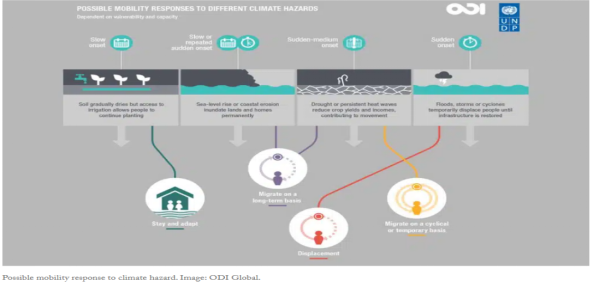
Popular discussions tend to start from startingly huge predictions of mass migration, yet the evidence points to a more nuanced reality. Most climate change- and natural disaster-related movement is internal rather than cross-border, and temporary rather than permanent. The likelihood of migration also depends on communities’ vulnerability to the impacts of climate change, which can be mitigated by adaptation measures such as building sea walls or other defenses, as well as individuals’ access to resources to move (including transportation, social networks, and legal pathways). There were 33 million natural disaster-related displacements in 2022, but the biggest displacement situations—from floods in Pakistan to droughts in East Africa—saw people move within their countries, at least at first. And by the end of the year, most disaster-displaced people went back to their homes.
Over time, a bigger issue may be migration prompted by slow, gradual climate change impacts. Hotter temperatures can threaten agricultural livelihoods, sea-level rise can make floods more severe, and desertification can foster conflict over water access, all of which can lead to migration. While rapid-onset disasters typically lead to short-term displacement, people may decide to move permanently or go farther away if events recur repeatedly or cause massive damage. The most vulnerable may end up with the fewest options to move or adapt if persistent climatic threats degrade their ability to respond. Thus, the core challenge is increasingly unpredictable mobility as climate change amplifies existing inequalities and insecurities across the globe.
Mobility is one response to the impacts of climate change, but not an inevitable one, nor is this movement always a negative development. As climate change makes livelihoods harder and disasters more severe, displacement is likely to grow and become more unpredictable, although government action can help individuals remain in place or move in safer, legal ways.
This article provides answers to basic questions about climate change and migration, starting with whether, how, and where climate change triggers migration and displacement. It also takes on questions such as who qualifies as a climate migrant and why there is no “climate refugee” designation.
Is Climate Change a Major Driver of Migration and Displacement?
Climate change is not the main reason why people move, but it is increasingly part of the story. Environmental issues are generally minor factors in people’s migration decisions, typically far behind economic imperatives even in highly climate-affected countries. For instance, in El Salvador, Guatemala, and Honduras, just 6 percent of migrant-sending households cited climate- and environment-related reasons for emigration, according to a 2021 report from the World Food Program, Migration Policy Institute, and Massachusetts Institute of Technology. Similarly, in Central Africa, just 5 percent of migrants reported they moved for environmental reasons, according to a Mixed Migration Centre survey published in 2022. However, when asked whether the environment affected their decision to move, 50 percent of Central African respondents agreed.
This reflects a key challenge in understanding how climate change affects migration. Environmental factors clearly play a role, but not a clear-cut one. In cases where disasters directly trigger displacement, the impacts of climate change may not be clear (some events such as earthquakes are not climate-related, and not all disasters can be attributed to climate change). Government policies are also equally important. Droughts in Syria have been linked to internal displacement that helped enable the Syrian civil war, but government decisions to cut rural subsidies, income security, and access to water resources have been found to be more critical.
Worldwide, natural disasters lead to more displacement than conflict, but this movement tends to be short term. Of the 71.1 million internally displaced people (IDPs) at the end of 2022, just 8.7 million (12 percent) were displaced by disasters. While insecurity and conflict often prevent residents from safely returning to their place of origin, in most cases people go back after natural disasters strike. The world recorded more than 20 million displacements due to natural disasters each year from 2019 to 2022, but most people did not stay displaced for long; fewer than 9 million remained internally displaced at the end of each year.
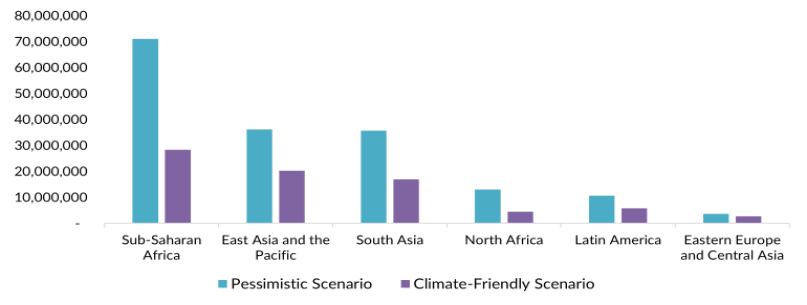
Most disaster-related displacement is short term, but migration related to slow-onset climate change may be more permanent and possibly large-scale. Sea-level rise, land degradation, coastal erosion, extreme temperature, and other gradual impacts of climate change can make entire areas (or in some cases, entire islands) unlivable, threaten the viability of rural livelihoods, and foster competition over resources. These types of changes can also make the repercussions of sudden disasters more severe, for instance when floods and storms layer on top of longer rainy seasons or higher sea levels. In a highly cited prediction, the World Bank’s worst-case estimate is that some 216 million people could move internally by 2050, as water becomes scarcer and agricultural livelihoods are threatened. However, if governments mitigate the pace of climate change and adapt to its impacts, the World Bank predicts this number could drop by as much as 80 percent, to 44 million (see Figure 1).
As a general rule, natural disasters force lots of people to flee, but mostly to nearby neighborhoods from where they quickly return, while slower-onset climate events may over time lead to more migration, including across borders. Yet there are signs this binary is dissolving as sudden and slow-onset events overlap, and as disasters become more frequent and their impacts more severe.
One recent example was the 2022 floods in Pakistan, which displaced an estimated 8 million people and caused approximately U.S. $30 billion in damages. Movement was at first internal, primarily of people evacuating to higher ground. But the floods hit a country already grappling with economic collapse and rampant inflation; just months later, thousands of Pakistanis migrated irregularly to Europe, a movement that captured headlines when a boat carrying approximately 350 Pakistanis and hundreds of other migrants capsized off the coast of Greece. Pakistanis were not among the top ten nationalities arriving irregularly in Europe in 2022, but jumped to fifth in the first half of 2023. Many of these migrants moved primarily because of economic reasons, but these factors were surely amplified by the floods.
Box 1. Problematic Numbers
In climate mobility discussions, misinterpretation of data often inflates fears of mass migration, typically in one of the following ways:
Assuming all people exposed to climate change, or living in countries highly vulnerable to climate change, will migrate and do so internationally.
Conflating short-term displacement with permanent migration, ignoring that most disaster-displaced people return to their place of origin.
Using estimates of all displacement, rather than that linked to climate change and natural disasters.
A thoroughly debunked but nonetheless widely circulated estimate predicts there will be as many as 1.2 billion climate migrants by 2050, a number derived simply by reviewing annual displacement data and assuming all people will remain displaced forever. Other estimates, such as that 80 percent of climate migrants are women, simply circulate with no discernable analysis or methodology. These types of big numbers can be misrepresented for a variety of reasons, including to limit immigration or bring more urgency to the vulnerabilities of climate migrants.
A critical limitation is that it is nearly impossible to estimate how many people will be able to move internationally because of climate change-related impacts. The critical factor in this regard will likely be migration and border policies and how governments choose to manage and respond to environmental displacement, which cannot be captured by scientific projections.
There is no consensus around who counts as a climate migrant, which unlike other types of migrants is not a legally defined category. Since climate change often interacts with other drivers of migration—including economic factors, political unrest, and conflict—a broad swath of people could be said to be moving in part because of environmental degradation or climate impacts. The proliferation of terms about the topic has added to the confusion. Phrases such as “climate refugees” ignore that climate change is not itself grounds for refugee protection; although there are some regional or national migration policies designed for disaster-displaced people, these do not generally apply to all individuals who move because of the indirect impacts of climate change (see below). As such, climate mobility is perhaps the broadest umbrella term for the phenomenon, covering internal and international movement, whether forced or voluntary, temporary or permanent.
The flip side of this issue is that there are many people affected by climate threats who do not move, either by choice or because they are not able to do so. So-called trapped populations who want to flee from climate-affected areas but lack money or other resources are disproportionately marginalized people and often face greater harms staying in dangerous situations than migrants who leave.
From Where Are People Leaving?
The impacts of climate change are being felt all over the world, and thus climate-related migration occurs globally. But the impacts are unequal, and the most severe migration and displacement is often occurring in low- and middle-income countries that have made little historical contribution to warming the planet. This is why displacement is often described as the “human face” of the losses and damages caused by climate change.
Yet even in high-income countries, climate change is already reshaping migration. According to U.S. Census Bureau data, 3.2 million U.S. adults were displaced or evacuated due to natural disasters in 2022, of whom more than 500,000 had not returned by the beginning of 2023 (see Figure 2). The U.S. government has also begun to assist relocation of entire communities, including Native American villages and neighborhoods highly vulnerable to sea-level rise. Public concerns over future displacement are significant in high-income countries. In a 2019-20 European Investment Bank survey, 24 percent of Europeans (and 41 percent of young Europeans) thought they would have to move because of climate change. In the United States, 30 percent of respondents in a 2022 Forbes Home survey cited climate change as one reason why they might move.
I. The Development Divide
To understand climate migration, we must confront the development divide—a concept describing how inequalities in economic resources, infrastructure, governance, and adaptive capacity shape who suffers most from climate impacts and who can respond most effectively.
Unequal Vulnerability
Climate change does not affect all regions equally. Developing countries—especially those in Africa, South Asia, the small island states of the Pacific and Caribbean, and parts of Latin America—are disproportionately affected by climate shocks. These regions often lack resilient infrastructure, early-warning systems, health services, social safety nets, and economic buffers. Climate impacts there lead to loss of livelihood, food insecurity, and forced mobility at rates far higher than in many advanced economies.
At a global scale, the countries that have contributed least to greenhouse gas emissions tend to suffer most from climate impacts. This moral asymmetry intensifies development inequalities and raises questions about climate justice. How should responsibility and resources be distributed? Who should support communities forced to leave homelands that are becoming uninhabitable?
Migration as Development Outcome
Migration can be a result of limited development pathways. Where agricultural yields decline due to drought, where homes are washed away by coastal erosion, or where temperatures reach levels unsafe for human labor, people may move not out of preference but necessity. In some contexts, migration is circular or temporary—seasonal labor movements after environmental stress. In others, it becomes permanent displacement.
The development divide also shapes how well receiving communities absorb climate migrants. Wealthier cities or countries may have infrastructure, jobs, and social services to integrate newcomers. Poorer areas may lack these capacities, leading to overcrowded settlements, increased competition for resources, and social tensions.
Addressing climate migration therefore requires reducing the development gap—strengthening resilience in vulnerable regions, ensuring equitable access to adaptation resources, and creating development pathways that allow people to stay safely if they choose.
II. Opportunities and Challenges
Opportunities:
- Innovative Solutions and Resilience Building: Climate migration can drive the development of new infrastructure, urban planning, and sustainable practices in host communities, fostering resilience and adaptive capacity.
- Economic Growth and Cultural Diversity: Migrants can contribute to local economies through entrepreneurship, labor, and cultural exchange, enriching the social fabric of host regions.
- Strengthening Global Cooperation: Addressing climate migration encourages international collaboration on climate policies, humanitarian aid, and development programs, fostering a more unified global response.
- Advancing Climate and Human Rights Awareness: The crisis highlights the urgency of tackling climate change and promoting human rights, potentially spurring policy changes and increased funding for sustainable development.
Challenges:
- Humanitarian and Social Strain: Sudden influxes of climate migrants can overwhelm local resources, healthcare, and social services, leading to tensions and social conflicts.
- Legal and Policy Gaps: Lack of comprehensive legal frameworks to protect climate migrants leaves many vulnerable to exploitation, statelessness, and discrimination.
- Environmental and Infrastructure Pressure: Increased population in certain areas can strain ecosystems, infrastructure, and resources, potentially exacerbating environmental degradation.
- Economic and Political Instability: Migration can lead to economic disparities and political tensions within and between countries, complicating governance and policy responses.
III. Strategies for Balanced Climate and Development Pathways
To address climate migration effectively, strategies must balance environmental sustainability, human rights, economic growth, and social equity. A holistic approach is required—one that connects climate science, development planning, and humanitarian policy.
Invest in Climate-Resilient Development
Adaptive infrastructure—such as flood barriers, drought-resilient agriculture, and early warning systems—reduces the need for forced migration. Investment in climate resilience must prioritize areas with high vulnerability and low adaptive capacity.
Enable Safe, Legal Migration Pathways
Governments and international bodies can create visa categories, labor mobility agreements, and humanitarian corridors specific to climate migrants. Such measures recognize migration as a legitimate response to environmental change and provide legal protections.
Community-Led Planning
Local communities often have deep knowledge of environmental change and adaptive practices. Planning mechanisms should involve communities in decisions about relocation, livelihood diversification, and resource management.
Urban Planning and Inclusive Cities
As migration increasingly flows toward cities, urban planning must expand housing, transportation, sanitation, employment, and green infrastructure. Policies should ensure that migrants are integrated as contributors rather than perceived as burdens.
Social Safety Nets and Livelihood Programs
Social protection systems—including unemployment support, health access, and training programs—help both migrants and host communities adapt. Livelihood programs can equip people with skills for climate-smart jobs.
IV. Policy Frameworks and Historical Context
Understanding climate migration requires situating it within both the history of human mobility and evolving policy landscapes.
Historical Migration Patterns
Migration has been a constant in human history—people moving for trade, conquest, exploration, or survival during famine and epidemics. Environmental factors historically influenced human settlement patterns: river floodplains offered fertile ground but periodic inundation; droughts prompted seasonal mobility in pastoral societies.
What is new in the twenty-first century is the scale and pace of climate change and the interconnectedness of global systems. Climate drivers now combine with economic globalization, political conflict, and demographic shifts to produce complex migration dynamics.
International Policy Landscape
International policy on climate migration remains fragmented:
The 1951 Refugee Convention does not include climate change as grounds for asylum.
The United Nations Framework Convention on Climate Change (UNFCCC) recognizes displacement as a climate impact but lacks binding migration policy mechanisms.
The Global Compact for Safe, Orderly and Regular Migration (2018) acknowledges climate change as a driver of migration and promotes cooperation, but it is non-binding and voluntary.
Regional efforts—such as Pacific Island agreements on relocation or African Union frameworks on free movement—offer models but lack full implementation. National policies vary widely, with some countries integrating climate risk into planning, while others lack guidance altogether.
Effective policy requires bridging the gap between climate science and migration governance. Policies must be anticipatory rather than reactive—recognizing early signs of displacement risk and integrating migration into climate adaptation strategies.
V. Case Studies in Integrated Development
Examining real-world examples illustrates how climate, development, and migration intersect—and how integrated responses can mitigate harm and expand opportunity.
Bangladesh: Coastal Resilience and Urban Migration
Bangladesh is one of the world’s most climate-vulnerable nations. Sea-level rise, cyclones, and riverbank erosion have displaced millions, prompting migration to Dhaka and other urban centers. The government and development partners have implemented coastal afforestation, cyclone shelters, and early warning systems to reduce displacement risk.
However, urban migration strains housing, sanitation, and employment in cities. Innovative responses include planned urban expansion with affordable housing, skills training for migrants, and microfinance programs that enable entrepreneurship.
The Sahel: Drought, Pastoralism, and Mobility
In the Sahel region of Africa, recurrent drought has undermined traditional pastoralist livelihoods. Pastoral communities increasingly migrate seasonally in search of grazing and water. Cross-border mobility is part of cultural tradition, but climate stress intensifies competition with agricultural communities.
Regional cooperation efforts—such as agreements on transhumance corridors and shared resource management—aim to reduce conflict and improve resilience. Community-driven adaptation projects support drought-resistant crops and water management to reduce forced relocation.
Pacific Island States: Sea-Level Rise and Planned Relocation
Low-lying Pacific Island nations like Kiribati and Tuvalu face existential threats from sea-level rise. Some communities are engaging in planned relocation—moving entire villages to higher ground or to other countries. This approach raises complex questions about identity, sovereignty, and cultural continuity.
Partnerships with other nations provide training, education, and legal pathways for relocation (e.g., labor mobility schemes), while efforts at home focus on preserving cultural heritage amidst change.
U.S. and Caribbean: Hurricane Displacement
Hurricanes such as Katrina (2005) and Maria (2017) caused massive internal displacement in the United States and Caribbean. Recovery efforts revealed gaps in housing policy, disaster response, and social support. Lessons from these events emphasize the need for resilient housing, equitable rebuilding funds, and integration of displaced populations into long-term planning.
VI. Recommendations for Policy Prioritization
Addressing climate migration at scale requires policymakers, scientists, civil society, and the private sector to act in concert. Below are key recommendations to prioritize:
1. Recognize Climate Migration in Legal Frameworks
Expand refugee and humanitarian protection definitions to include climate displacement.
Develop bilateral and regional agreements that facilitate safe, legal movement.
Ensure migrants have access to work permits, education, and social services.
2. Integrate Migration into Climate Adaptation Planning
National adaptation plans should include migration risk assessments and response strategies.
Funding mechanisms (e.g., Green Climate Fund) should support projects that reduce displacement risk.
3. Invest in Resilience at Source
Strengthen infrastructure, disaster preparedness, and early warning systems in vulnerable regions.
Support livelihood diversification (e.g., climate-smart agriculture, renewable energy jobs).
4. Build Inclusive Cities
Urban planning must prioritize affordable, resilient housing and access to services.
Encourage community-based integration programs to foster social cohesion.
5. Prioritize Data and Research
Develop standardized data on climate migration to inform policy.
Support social science research on how communities adapt, migrate, and recover.
6. Center Equity and Justice
Ensure that policies acknowledge historical responsibility for emissions.
Allocate funding and resources to the most vulnerable communities first.
Empower local leaders and indigenous voices in decision-making.
7. Strengthen International Cooperation
Create multilateral mechanisms for shared responsibility in relocation, resettlement, and financial support.
Align climate policy, migration governance, and human rights frameworks.
Conclusion
Climate migration sits at the intersection of environmental science, human rights, development economics, and global governance. As climate impacts intensify, migration will increasingly become both a necessity and an opportunity—if policies and practices anticipate, rather than react to, crises. Understanding this phenomenon as a scientific and humanitarian crisis compels us to combine rigorous research with compassion, ensure that the most vulnerable are not left behind, and craft systems that enable human mobility to be dignified, safe, and productive.
Addressing climate migration is not simply about moving people from place to place. It is a test of our collective ability to build societies that are fair, flexible, and resilient; to value human dignity in the face of global change; and to create a world where no one is forced to choose between survival and hope.