
Introduction
Human-caused climate change is one of the most complex and urgent challenges of the 21st century. At the core of climate mitigation efforts lies the need to drastically reduce carbon dioxide (CO₂) emissions — the primary greenhouse gas driving global warming. While transitioning to renewable energy, electrification, and energy efficiency are essential, many scientists, policymakers, and business leaders also argue that carbon capture technology — especially Carbon Capture, Utilization, and Storage (CCUS) — is necessary to address emissions that are hard to eliminate through other means. Supporters frame it as a mature technological pathway that can enable net-zero goals and preserve industrial competitiveness; critics argue it’s a false hope, diverting resources from proven solutions like renewables and energy conservation.
Carbon capture technology has been hailed by some as a breakthrough climate solution and by others as overhyped and underperforming. As nations strive to hit net-zero emissions and companies tout their green credentials, carbon capture has emerged as a central but controversial piece of the climate puzzle. But separating truth from marketing requires understanding the science, the economics, and the real impact so far.
This article digs into how carbon capture works, where it’s being deployed, what it can and can’t do, and why the debate matters right now.
What Is Carbon Capture? A Clear Look at the Concept
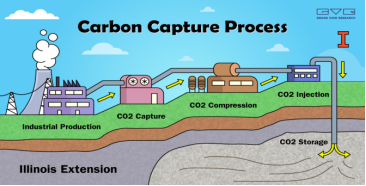
At its core, carbon capture refers to technologies designed to remove carbon dioxide (CO₂) from large point sources — like power plants, cement factories, or steel mills — or directly from the air. Once captured, the CO₂ can be stored underground, used to make products (like building materials), or injected for enhanced oil recovery.
There are two main pathways:
- Carbon Capture and Storage (CCS): Capturing emissions before they enter the atmosphere and storing them permanently underground.
- Direct Air Capture (DAC): Pulling CO₂ directly from ambient air — a more diffuse and energy-intensive process.
Both methods are rooted in well-understood chemical and physical processes, but their real-world application varies dramatically in cost, scale, and readiness. For a primer on how these approaches work — and why they’re so different — the U.S. Department of Energy offers a clear overview of carbon removal technologies.
Why Carbon Capture Sounds Like a Miracle
The appeal of carbon capture is obvious: it promises to remove greenhouse gases at scale without forcing immediate reductions in energy use or industrial output. In theory, it can be retrofitted to existing infrastructure (like fossil fuel plants) and even pull emissions from sectors that are otherwise hard to decarbonize, such as cement and steel production.
Proponents of carbon capture point to several advantages:
- It can reduce emissions from existing industrial sources without shutting them down.
- When paired with storage or utilization, it can theoretically achieve net-negative emissions.
- It offers a technological path for industries that lack cheap renewable alternatives.
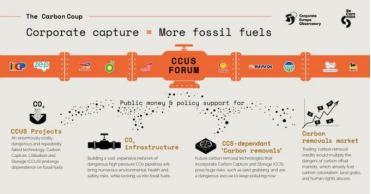
These strengths have led to major investments from governments and corporations eager to demonstrate climate action, often bolstered by tax incentives or funding programs. In the United States, for example, incentives under tax codes like Section 45Q offer financial credits for captured and stored CO₂.
CARBON CAPTURE AND STORAGE IS A FALSE SOLUTION FOR THE CLIMATE AND OUR COMMUNITIES Carbon Capture and Storage, or CCS
Carbon Capture and Storage, or CCS, is a dangerous delay tactic championed by the fossil fuel industry and other polluters to continue business-as-usual while taking resources away from the needed transition to clean, cheaper renewable energy.
CCS is touted as a process to divert some of the carbon dioxide released from smokestacks. This CO2 is compressed, pushed under high pressure through pipelines, and ironically then used to pump more oil out of the ground — which when burned produces more CO2. Other problematic uses include making synthetic CO2-emitting fuels and polluting plastics and storing CO2 underground, typically in oil and gas fields that have a long history of leaks and blowouts. Bioenergy facilities incinerate trees and crop biomass — which provide natural carbon storage — to make electricity or fuels, releasing CO2 and toxic air pollutants. BECCS projects propose to capture some of this CO2 with CCS. BECCS projects have not shown that they are carbon negative or carbon neutral, as industry proponents claim. CCS has consistently proven to be exceptionally unsafe, ineffective, economically unsound, and unnecessary, despite decades of development and billions of dollars of investment. Bioenergy with CCS, or BECCS, comes with the safety, health, and climate dangers of CCS. And, given the heavy land use, resource requirements, and logging needed to feed BECCS facilities, it adds unacceptable harms to biodiversity and ecosystems, the climate, food and water security, and human rights.
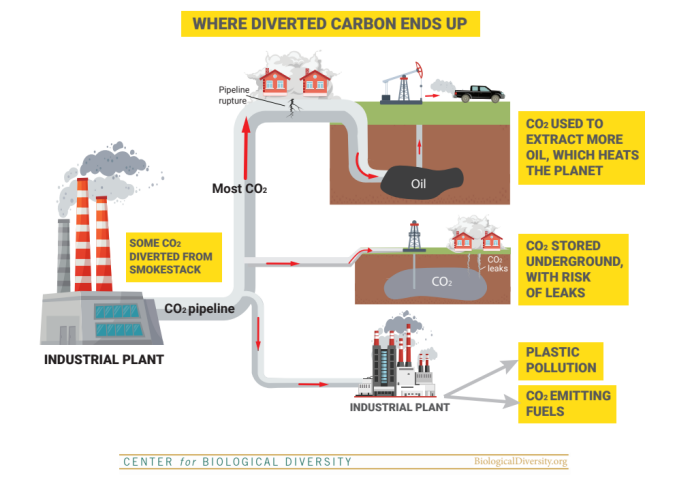
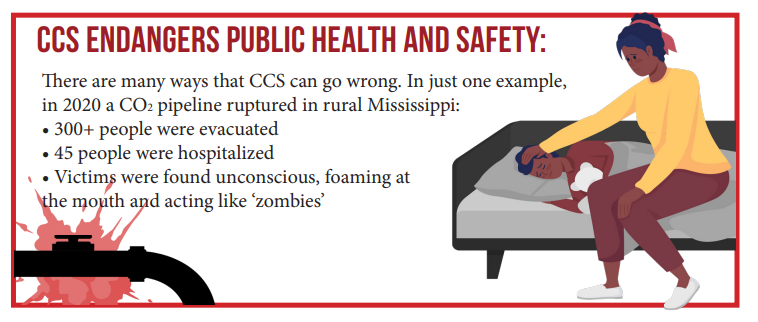
CCS is a dirty energy industry delay tactic. The science is clear that we must rapidly phase out fossil fuel production and use — and stop using all carbonemitting fuels like biofuels — to avoid the worst damages of the climate crisis. It should come as no surprise that the fossil fuel and bioenergy industries are pushing delay tactics to keep their dirty business afloat. Unsafe: CCS threatens the health and safety of our communities and adds to environmental injustice. Black, Indigenous and communities of color already overburdened by fossil fuel and bioenergy pollution are again being targeted for CCS infrastructure. CCS poses significant new health, safety, and environmental risks from toxic air pollution, pipeline ruptures, and leaks from underground CO2 storage that can sicken and even kill people. Ineffective: CCS is not a climate solution. In addition to rapidly phasing out fossil fuels, we must remove some existing CO2 from the atmosphere to keep global temperature rise below 1.5 degrees Celsius. This is called “carbon dioxide removal” or CDR. CCS does not remove existing CO2 from the atmosphere. In practice, it at best diverts a fraction of additional CO2 pollution produced from burning fossil fuels and other dirty fuels. Worse still, in the United States, virtually all the carbon diverted by CCS (95%) is used to extract oil, adding to the climate crisis. Any CO2 that is stored underground risks inevitable leakage back into the atmosphere, based on the long track record of fossil fuel industry leaks and blowouts. Economically Unsound: CCS is not economically viable and will cost billions of dollars in subsidies. It’s extremely expensive. Energy made using CCS and BECCS cannot compete with solar and wind energy, which are the most affordable electricity sources for most of the country. Likewise transportation fuels made using CCS and BECCS cannot compete with vehicle electrification. The public is already paying for CCS through taxpayer subsidies, and the fossil fuel and bioenergy industries are pushing for billions more dollars of public money to prop it up. Unnecessary: CCS is not needed to meet the international Paris Agreement climate limits. There is no need to pin our hopes on unsuccessful, unproven, and nonviable CCS and BECCS strategies in order to limit temperature rise to 1.5°C. We can meet the 1.5°C climate limit by investing in what works: (1) phasing out fossil fuels with an equitable transition to clean, renewable energy and (2) enhancing natural CO2 removal from the atmosphere by protecting forests, wetlands, and other carbon-rich ecosystems. Don’t fall for dirty energy industry disinformation. Fossil fuel and bioenergy companies are waging a deceptive PR campaign to promote CCS and keep the money flowing to their shareholders. CCS faces widespread opposition from frontline communities, scientists, and hundreds of environmental justice, climate, and environmental groups, including the White House Environmental Justice Advisory Council and the 1,500-group Climate Action Network.
We need real solutions.CCS and BECCS are not viable or just climate solutions. We must invest in an equitable transition to clean, renewable solar and wind energy, battery storage, and electric vehicles that upholds environmental justice, ensures no worker or community is left behind, and ends fossil fuels and other dirty energy
Real-World Projects: Successes and Shortfalls
Several high-profile carbon capture projects offer a mixed picture.
Success Stories:
- Boundary Dam (Canada): One of the first commercial CCS installations; it captures CO₂ from a coal power plant and stores it underground. Yet even this project faced cost overruns and operational challenges.
- Gorgon Carbon Dioxide Injection Project (Australia): Operated by Chevron, this project captured millions of tons of CO₂ from a liquefied natural gas facility.
Shortfalls and Delays:
Some announced projects have been delayed, downsized or canceled due to cost increases, technical issues, or regulatory hurdles. In several cases, the touted emissions reductions fell short of expectations, prompting critics to question whether public funds and incentives should instead focus on renewables and efficiency.

Carbon Capture vs. Emissions Reductions: Complementary or Competing Goals?
A central debate within climate policy circles is whether carbon capture is a complementary tool or a distraction from primary emissions reductions — such as switching to renewables or electrifying transportation.
Critics argue that subsidies and political support for carbon capture can:
- Delay necessary emissions reductions by providing an excuse to continue burning fossil fuels.
- Redirect capital away from clean energy deployment that is more cost-effective today.
- Create a false sense of security around climate pledges without delivering real results.
Proponents counter that carbon capture is essential for hard-to-abate sectors like cement and steel, where alternatives are not yet widely available. They also point out that capturing legacy emissions — carbon already in the atmosphere — may be necessary to meet long-term climate targets.
This balancing act underscores the need for a climate strategy that prioritizes emissions avoidance first, and uses carbon capture strategically where reductions are not feasible.
The Future of Carbon Capture: Innovation or Infrastructure?
Looking ahead, the trajectory of carbon capture hinges on several factors:
- Cost Reductions: Breakthroughs in materials science, process engineering and economies of scale could bring down costs.
- Clean Energy Availability: Affordable, carbon-free power is essential for DAC systems to deliver net benefits.
- Policy Frameworks: Long-term incentives, reliable carbon pricing, and clear regulatory pathways will influence deployment.
- Public Acceptance: Safe and socially responsible storage — especially underground — requires community trust and oversight.
Some forward-looking scenarios imagine carbon capture systems integrated with bioenergy (BECCS) or paired with direct utilization — turning captured CO₂ into fuels, plastics or building materials. However, these pathways are still in early stages and often struggle to justify economic viability without subsidies or markets for the resulting products.
- Development Divide
What Is Carbon Capture Technology?
At its core, carbon capture involves trapping CO₂ produced from industrial activities or directly from the atmosphere, then transporting and either storing it permanently underground or using it in industrial applications. There are different forms of carbon capture:
- Post-combustion capture — capturing CO₂ from flue gases after fossil fuel or industrial combustion.
- Pre-combustion capture — separating carbon before combustion in processes like gasification.
- Oxy-fuel combustion — burning fuel in pure oxygen to produce a CO₂-rich exhaust that is easier to capture.
- Direct Air Capture (DAC) — capturing CO₂ directly from ambient air rather than from a point source.
These technologies together form the broader CCUS landscape that many analysts believe can contribute to climate mitigation.
Where We Are Today
Despite years of research and investment, global deployment remains limited relative to the scale of emissions. According to recent reviews, even after billions of dollars in investment, CCS captures a fraction (well under 1%) of global CO₂ emissions annually — far less than what climate models suggest is necessary to meet key climate targets.
This divergence underpins the development divide — between places where carbon capture is gaining ground (often backed by government subsidies or fossil fuel investments) and places where it remains theoretical or economically unviable.
For example:
- In Norway, large-scale CCS projects like Longship and Northern Lights have begun operations, storing CO₂ offshore and supported by government subsidies totaling billions of dollars.
- In India, collaborative research efforts such as pilot geological CO₂ storage drilling by NTPC and IIT-Bombay are exploring domestic storage potential — an important research milestone in an emerging economy.
- In Australia, large proposed projects face criticism as critics warn that CCS could become a “carbon dumping ground”, channeling fossil fuel emissions underground without preventing continued oil and gas extraction.
II. Opportunities and Challenges
Opportunities
l Mitigating Hard-to-Abate Emissions
- One of the strongest arguments for carbon capture is that some sectors — like cement, steel, and certain chemical industries — currently have few alternatives for reducing process emissions. CCUS could provide a critical tool to reduce emissions where energy transitions alone are insufficient.
l Historical and Ongoing Sequestration Proofs
- Projects like Norway’s Sleipner injection (operational since the 1990s, storing millions of tonnes of CO₂) demonstrate that geological sequestration can work over long periods.
l Industrial Integration and Economic Opportunities
- Large infrastructure investments like pipelines and storage hubs — such as the Alberta Carbon Trunk Line System in Canada — serve both carbon capture and economic activity.
Moreover, capturing carbon and using it for enhanced oil recovery (EOR) or other applications can create market incentives — though this is also controversial (more on that below).
Challenges
While the potential for CCUS exists, its practical deployment faces major challenges.
l High Costs and Energy Demand
- CCUS technologies are expensive to install and operate. The capture stage — particularly DAC — remains energy-intensive and costly, often requiring significant subsidies or high carbon prices to be commercially viable. Without these incentives, deployment stalls.
l Limited Climate Impact at Current Scale
- Empirical research suggests that CCUS currently captures negligible percentages of total global emissions; achieving climate-relevant scales would require monumental scaling that has not yet materialized.
l Questions About Long-Term Storage and Leakage
- Underground storage is not risk-free; geological conditions vary, and public confidence in long-term trapping is often low. Regulatory and monitoring systems must address safety, leakage risks, and community concerns.
l Potential for Greenwashing and Fossil Fuel Backsliding
A core criticism is that CCS has been used by some companies primarily to avoid reducing emissions at the source, or to justify continued fossil fuel extraction. Critics worry it can become greenwashing — a way to claim climate action without substantial emissions reductions. — especially when captured carbon is used for enhanced oil recovery, which ultimately produces more fossil fuels.
III. Strategies for Balanced Development
A key to assessing whether carbon capture is realistic rather than mythical lies in designing balanced, evidence-based strategies that acknowledge its limitations while maximizing real benefits.
l Prioritize Emission Reduction First
Carbon capture should be positioned as a complement — not a substitute — to aggressive emissions reduction strategies like renewable deployment, electrification, energy efficiency, and behavioral change.
l Invest in Practical Pilot and Demonstration Projects
Subsidized, well-monitored projects such as those in Norway help build technical competency, establishing best practices in capture, transport, monitoring, and storage.
l Enhance Research on Economies of Scale
Targeted research — especially into DAC and post-combustion capture at scale — can help reduce costs and energy intensity. Ideally, breakthroughs will lower the price per tonne of CO₂ captured and improve efficiencies.
l Encourage Carbon Utilization Innovation
Using captured carbon in chemicals, building materials, or fuels (where it displaces fossil carbon) may improve economics. However, utilization must genuinely reduce lifecycle emissions rather than simply recycle the carbon back into the atmosphere later.
l Community Engagement and Transparency
Local communities must be part of the planning and monitoring process, ensuring that storage sites are safe, environmentally just, and trusted.
IV. Policy Frameworks and Historical Context
Early Frameworks and International Goals
Policy design is central to carbon capture deployment; unlike renewables, CCUS generally does not create electricity revenue unless there are incentives tied to carbon pricing or credits. A comprehensive policy framework is essential to bridge the economic gap.
The International Energy Agency (IEA) has long emphasized the need for cohesive CCS policy support to drive deployment, noting that incentives, regulations, and carbon pricing frameworks are critical to overcome barriers.
Recent Policy Trends
Many developed economies have adapted CCUS policy measures:
- The U.S. expanded tax credits and funding mechanisms under recent infrastructure legislation to subsidize carbon capture technologies.
- The European Union’s Green Deal and standardization initiatives (like CEN/TC 474) aim to establish cross-border frameworks for CCUS deployment.
Historical Setbacks and Lessons
Ambitious early projects like the White Rose Project in the UK were cancelled due to lack of funding and policy support — demonstrating that even promising initiatives can fail without sustained backing.
The cancellation of such projects offers key lessons: developers and governments must align long-term visions, financing, and regulatory certainty to avoid repeated volatility in carbon capture deployment.
V. Case Studies in Integrated Development
Examining real cases helps clarify when carbon capture has been effective — and when it has fallen short.
1. Northern Lights (Norway)
One of the globe’s most advanced CCS infrastructures, Northern Lights has successfully begun storing captured CO₂ beneath the North Sea. With government backing and multi-national energy partners, this project demonstrates that carbon capture can transition from concept to operation at meaningful scale — particularly with policy support.
2. Alberta Carbon Trunk Line (Canada)
This project demonstrates how capturing CO₂ and transporting it via pipeline to storage or EOR operations can build an economic hub of carbon management, creating jobs and infrastructure while also trapping millions of tonnes of CO₂ per year.
3. Quest Project (Canada — Shell)
The Quest CCS initiative has captured millions of tonnes of industrial CO₂ emissions, but studies also show that not all emissions at the site were captured — illustrating both technological feasibility and operational limitations.
4. Emerging Projects and Criticisms
Proposals like the Bonaparte CCS project in Australia illustrate how large projects can generate controversy and skepticism, especially if critics view them as potential “carbon dumping grounds” that fail to meaningfully reduce net emissions.
VI. Recommendations for Policy Prioritization
To avoid misallocation of resources and to maximize beneficial outcomes, policymakers should consider the following recommendations:
1. Integrate Carbon Capture Within Broader Climate Policy
CCUS should be viewed as part of a suite of solutions — not a magic bullet. Broader climate strategies must prioritize emissions reduction at source while using carbon capture for unavoidable emissions.
2. Strengthen Carbon Pricing Mechanisms
Robust carbon prices or trading schemes that reflect the true cost of emissions can make carbon capture more economically viable.
3. Provide Long-Term Certainty for Investors
Long-term policy clarity — including subsidies, credits, and regulatory frameworks — should be established to attract private investment and reduce risk.
4. Support R&D and Cost-Reduction Pathways
Funding research into advanced capture materials, lower-energy processes, and better storage monitoring increases the odds that CCUS can scale sustainably.
5. Ensure Environmental Justice
Policymaking must involve affected communities and ensure that storage sites and carbon capture facilities do not disproportionately burden vulnerable populations.
Conclusion
So, is carbon capture technology a realistic solution or a false hope?
The answer is both — depending on how it is framed and deployed.
- As a standalone climate savior, carbon capture remains unrealistic due to current costs, limited deployment, and scale issues.
- As part of a holistic climate strategy, however — especially for hard-to-decarbonize industries and legacy emissions — CCUS plays a supportive role that complements deep emissions reductions elsewhere.
Whether carbon capture becomes a tool that truly assists global decarbonization, or instead becomes a costly detour that delays fundamental changes in how we produce and consume energy, hinges on policy design, investment strategy, transparency, and integration with broader climate goals.
In short, carbon capture is not a silver bullet — but it is not a hopeless illusion either. Its future relevance depends on our collective choices in governance, innovation, and climate ambition.
The truth about carbon capture is nuanced. It is neither a miracle solution that will magically reverse climate change, nor is it useless. It occupies a middle ground — a specialized tool with potential value in specific applications, but not a replacement for aggressive emissions reductions at the source.
For policymakers, investors, and climate advocates, the key is to recognize carbon capture’s role as part of a broader portfolio of climate strategies. Prioritizing clean energy deployment, efficiency, and electrification, while targeting carbon capture to sectors with limited alternatives, offers a balanced path forward.
Understanding the difference between promise and practicality will be essential in shaping climate policy that is effective, equitable, and grounded in real-world performance rather than hopeful rhetoric.