
Introduction
Colonialism remains one of the most debated phenomena in world history. Spanning several centuries, it reshaped continents, redrew borders, altered economies, and transformed cultures. European powers such as Britain, France, Spain, Portugal, Belgium, and the Netherlands expanded their territories across Asia, Africa, and the Americas, establishing political and economic control over vast regions. While some argue that colonialism introduced modernization, infrastructure, formal education systems, and global trade networks, others contend that it caused exploitation, cultural destruction, economic dependency, and long-lasting underdevelopment.
The central question—whether colonialism was a force for development or destruction—cannot be answered simply. Its impact was complex and uneven, varying across regions and communities. In some cases, colonial powers built railways, ports, and administrative institutions that later became foundations for modern states. In many others, colonial rule dismantled indigenous systems, extracted resources, enforced artificial borders, and created structural inequalities that persist today.
This essay critically examines colonialism through multiple dimensions: the development divide it created, the opportunities and challenges it presented, the strategies needed for balanced development in post-colonial states, policy frameworks within historical contexts, case studies of integrated development, and recommendations for future policy prioritization. Through this analysis, it becomes clear that while colonialism introduced certain developmental structures, its destructive consequences often outweighed its benefits, particularly in terms of social, economic, and cultural disruption.
Colonialization and Development
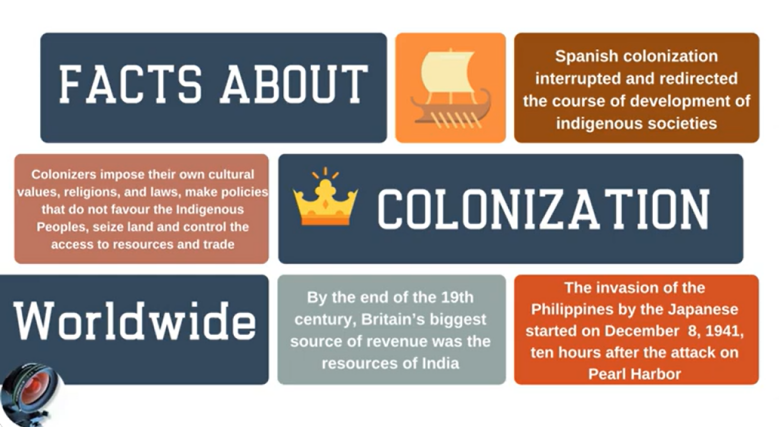
According to McMichael & Weber (2022), colonialism is the physical and psychological subordination of one culture by another—a colonial power—by the conquering of territory through military and economic means, as well as the stereotyping of the subjected culture. In short, colonialism is the control by one authority over a dependent region or population. In this section, we ask the reader to consider resources regarding colonialism, discuss the relevance of the resources to the topic, and examine the effects of colonialism on community development. Throughout colonialism, racism and stereotypes on “backwardness” were justified by a devaluation of other cultures and lifestyles. The European colonial system ended around the middle of the twentieth century. Still, its effects continue to be felt today in the form of poverty, racism, and neocolonialism, according to the Editors of Encyclopaedia Britannica (2020). The Editors of Encyclopaedia Britannica (2020) also state that the age of modern colonization began in 1492, following the discovery by Europeans of a sea route around the southern coast of Africa in 1488 and the discovery of the Americas—around 1500. There was settler colonialism in Canada as Europeans violently seized Indigenous people’s lands, ultimately drove them from their homes, and eventually vastly outnumbered them. The pre-colonial cultures were skilled at managing and producing resources to meet their material needs.
Moreover, their trading networks, spiritual beliefs, and social organization patterns were distinctive. Indigenous groups in what is now known as North America were vibrant, healthy, and had sophisticated and diversified societies. The pre-colonial African community relied on ancestral ecological wisdom and geocentric cosmology to survive. As described on Wikipedia (2022), contemporary research on colonialism often distinguishes between several overlapping categories of colonialism, including settler colonialism, exploitive colonialism, proxy colonialism, and domestic colonialism.
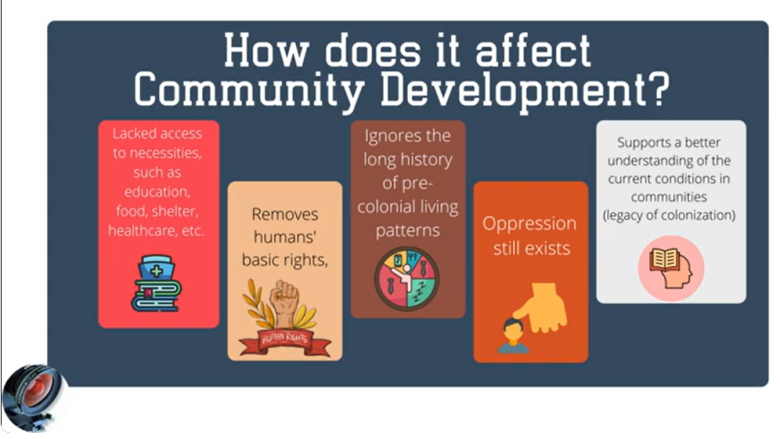
Community development is adversely affected by colonialism in several ways. The colonial system removes humans’ basic rights, which has a detrimental effect on the development of their communities. Ignoring the long history of pre-colonial living patterns, colonialism is consequently and inherently unsustainable, inadequate for an ongoing community development process. Since social justice was lacking among the colonized, community development was hampered, as the colonized were viewed as deserving no economic, political, or social opportunities or rights. Those colonized lacked adequate access in many ways to necessities such as education, food, shelter, healthcare, etc. Due to power imbalances resulting from race and oppression still exists after colonization. Compared to the colonial oppressed, Europeans have been given more opportunities and access to more services, including better treatment, and their way of life has been considered the “modern way of life.”
How is Colonialism Shown in Current Society?
How does comprehending the past aid us in understanding the present? After decades of colonization, it left a lasting impact on societies, which is reflected from the clothes we wear to the language we speak, where underdeveloped countries or countries with a high poverty rate are exploited for the production of products in economies where their human rights are violated. In the same way, our way of thinking changes, which leads to an increase in racism, exclusion of Indigenous communities, and inequality towards women.
Who’s Affected by Colonialism?
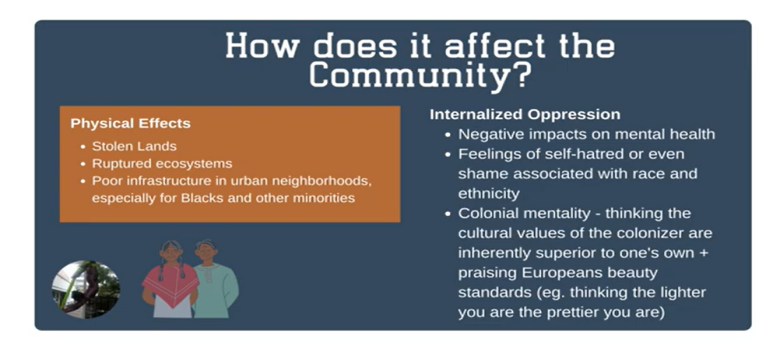
There were many ways in which colonization affected Indigenous people, both externally and internally. Their physical environment was affected by the removal of their lands, which resulted in environmental degradation. There was the destruction of Indigenous homes and the cutting down of trees. It negatively impacted several ecosystems and plants that Indigenous people consider medicinal. Moreover, it negatively affected the mental health of Indigenous people, thereby decreasing their level of well-being and by reducing their self-esteem; causing them to feel ashamed of themselves. Overall, colonialism affects everyone. It influences our views and perceptions of society, race, class, gender, culture, and sexuality.
How Can Indigenous People Get Their Land Back?
Several movements have been launched to help Indigenous people regain control over their lands, an example is the “LandBack” movement. According to Toastie (2022) the LandBack movement seeks to restore Indigenous political control over areas that activist groups and tribal members claim are theirs due to treaty rights. As stated on landback.org, “LANDBACK is more than a campaign, it is a political framework for deepening relationships among organizing movements working for true collective liberation” (para. 3). This framework enables us to visualize a world in which the liberation of Black, Indigenous, and people of colour (POC) coexists. Currently, Indigenous people are claiming their lands in battles across Turtle Island.
What We Learned from Course Readings
Colonialism was a power relationship where the colonizers appropriated and exploited these “unknown lands” and Indigenous people, while justifying it as a civilizing mission. From their point of view, it was a way of improving humankind; a social engineering project. This era brought social inequality, racial hierarchies, and “dependency” since these communities were categorized as undeveloped countries.
As Fernando Martinez, a Cuban politician, said, “Colonialism is the basic and decisive form of the universalization of commercial relations, the individualization of people, and the resistance of all against all” (2022, JGN). A good example of this is the large clothing companies. As we saw in class, many of these companies have their products made in other countries, such as Singapore and Colombia, since the cost of manufacturing and transportation is very low. Although the payment to the workers is not even half of what the garment they made will cost, these processes allow the generation of thousands of jobs worldwide and the continued working and generation of money within the global economy. Likewise, these underdeveloped countries are afraid to go against the developed countries since their income and economic growth, without foreign participation, seem insufficient to support an economy that circulates enough money to meet the basic needs of the people.
What Is Colonialism and How Did It Arise?
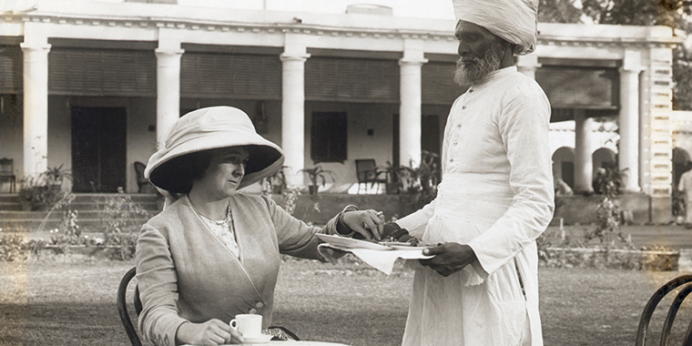
A Hindu servant serves tea to a European colonial woman in this undated photograph.
In the late seventeenth century, the Mughal Empire controlled almost all of the Indian subcontinent.
European visitors marveled at the empire’s wealth and grandeur. Antonio Monserrate, a Portuguese Jesuit missionary, called its cities “second to none either in Asia or in Europe with regards either to size, population, or wealth.”
For centuries, merchants around the world had traveled to India, eager to trade for coveted silk, spices, and textiles. And in 1700, India’s economy was larger than all of Western Europe’s put together, making up nearly 25 percent of the global economy. By 1973, however, that number had dropped to just 3 percent.
How did this happen?
The full story is long, winding, complex, and contentious. It involves centuries of war, technological innovation, and global trade that sent some economies soaring and brought others crashing down. But central to this story for India—and for so many countries around the world—is the history of colonialism.
This resource explores that history. What drove empires to conquer foreign lands? How did experiences vary under different types of colonialism? Who prospered through colonialism? And how are former colonies—now independent countries—faring today? We’ll begin with a survey of colonialism and then dive deep into the history of the world’s most populous colony, India.
What is colonialism?
Colonialism is the practice of controlling another country or area and exploiting its people and resources.
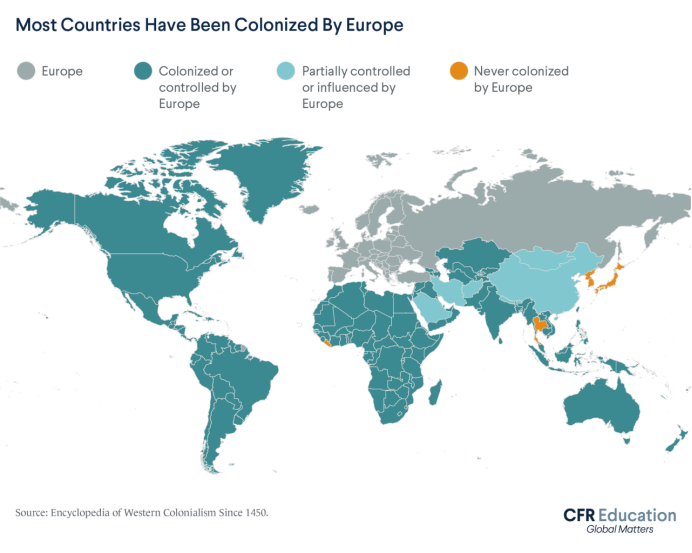
Between the late fifteenth century and the years after World War II, mostly European empires colonized the vast majority of the world. The French Empire, for instance, ruled over territory greater than the size of Europe. But the largest of these domains was the British Empire, which, at its peak, covered a quarter of the world. The sun was said to never set on the British Empire, as at least one of its colonies was always in daylight. Britain’s most important colony was India, the borders of which stretched from modern-day Afghanistan to Myanmar. So valuable was the colony that it accounted for half of the British Empire’s gross domestic product (GDP) in 1870.
What are the origins of colonialism?
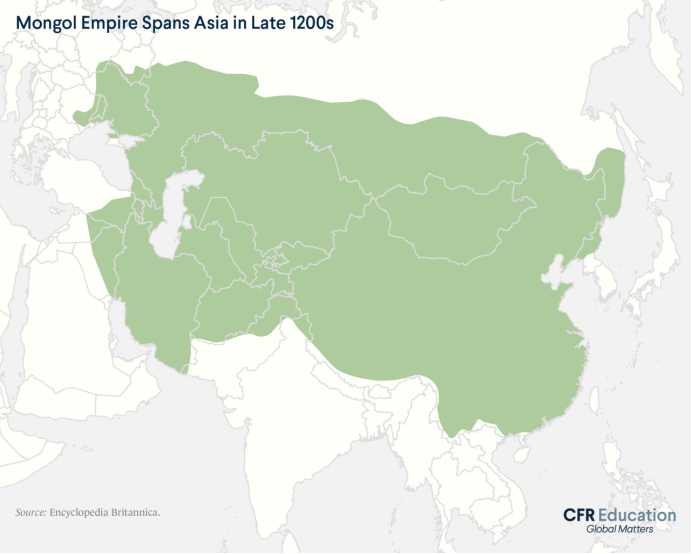
Empires have existed for thousands of years. In the second century, the Romans controlled territory from Western Europe to the Middle East. In the thirteenth century, the Mongols ruled an empire several times larger, which spanned Eurasia.
But the 1500s brought about a new age of empires as advanced naval technology allowed countries to expand their borders across oceans. Spain and Portugal quickly established colonies around the world. Other European powers—such as England, France, and the Netherlands—launched their own empires by the seventeenth century. And by the turn of the twentieth century, both the United States and Japan had claimed overseas lands.
Why did countries pursue colonies? Let’s explore a few reasons:
Raw Materials: Colonies provided access to gold, silver, and cash crops such as sugar and tobacco. During the Industrial Revolution, demand for cotton, tin, and oil drove further colonization of resource-rich areas, including sub-Saharan Africa and Southeast Asia.
Captive Markets: The Industrial Revolution also meant that European countries began producing goods at unprecedented rates. Eager to maximize profits, empires required many of their colonies to purchase those goods, often at marked-up prices. And in several instances, empires imposed burdensome regulations on local producers to prevent them from competing with European companies.
Religion: Some religious leaders and missionaries saw in colonialism the opportunity to convert hundreds of millions of people to Christianity. They perceived colonialism in a beneficial light, believing it could help people whom they viewed as backward, uncivilized, and unsaved from eternal damnation.
Prestige: European countries competed fiercely with each other and viewed colonies as symbols of their strength. This desire to demonstrate power and prestige largely motivated Germany, whose states had united as one country in 1871, to pursue colonies in Africa.
What did colonialism look like?
Broadly speaking, two types of colonies existed: settler colonies and extractive colonies.
Settler colonialism and extractive colonialism
In settler colonies, emigrants—often whole families—moved abroad in large numbers. They established permanent homes in the modern-day United States as well as Australia, Canada, New Zealand, South Africa, and other countries throughout the seventeenth, eighteenth, and nineteenth centuries. Settlers constructed their own farms, schools, and churches in those lands while often maintaining economic and political ties with their mother country. But in creating those communities, settlers killed and displaced indigenous people. In what became the United States, the indigenous population fell by 57 percent between 1700 and 1820.
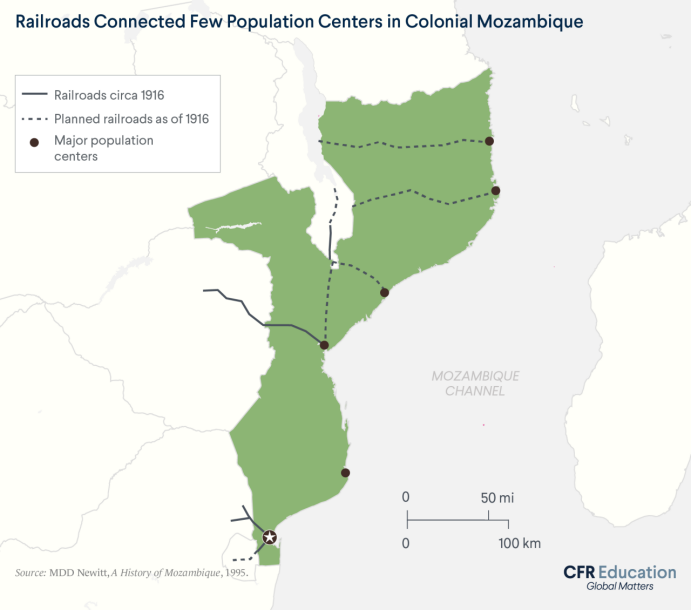
In extractive colonies, empires cared less about building settlements and more about transferring as much wealth as possible to the homeland. In certain instances, extractive colonies emerged through foreign conquest; other times, they came about through negotiation and alliances with local leaders. Slavery was common in many of these colonies. Britain, France, Portugal, Spain, and others used enslaved labor in the Western Hemisphere to grow coffee and sugar and mine gold and silver beginning in the fifteenth, sixteenth, and seventeenth centuries. Extractive colonies became even more prevalent in the nineteenth century as Europe colonized new parts of the world. In colonial Mozambique, for example, the Portuguese developed a network of railways in the late 1800s to transport vast quantities of coal and other minerals from inland mines to coastal ports.
Direct rule and indirect rule
Yet another distinction existed in how empires administered their colonies. The French, for example, frequently imposed direct rule. This meant that in places like West Africa, the French attempted to transform local societies by implementing European-style bureaucracies, laws, and education systems. The British, on the other hand, often practiced indirect rule. In large parts of India, the British focused on resource extraction and security concerns but preserved indigenous traditions and delegated daily governance to local rulers.
As a result of these differences, colonial experiences varied widely. Some people felt little change to their everyday lives. Others faced violence, political persecution, and restrictions on their language, culture, and religion. One of the most brutal colonial experiences occurred in the Congo, where the Belgian government imposed a system of racial segregation, barred Congolese from nearly all higher education opportunities, and prohibited free speech, assembly, and travel. An estimated ten million Congolese died under Belgian rule between 1884 and 1908.
Every colonial experience was unique, but exploring a single case study can help clarify how empires exerted their strength and extracted wealth from their colonies. For the rest of this lesson, let’s walk through the story of India, which became the largest colony of the world’s largest empire.
Colonialism in India
European trade with the Indian subcontinent took off in the early 1500s when the Portuguese began purchasing Indian spices that catered to the tastes of European high society. The trade proved so lucrative that quickly many other countries wanted a share. In 1600, Queen Elizabeth I signed a charter approving the establishment of the British East India Company, which would operate a monopoly on British trade with India.
The East India Company started as a small, private business headquartered in London, with outposts in the Indian ports of Bombay (now Mumbai), Calcutta (now Kolkata), and Madras (now Chennai). It seized the opportunity to expand when political divisions and invasions from neighboring Persia severely weakened India’s Mughal Empire. By 1757, the East India Company had gained control of the wealthiest Mughal provinces through alliances with regional governors and support from the British government (where many parliament members were themselves company shareholders).
Over the following hundred years, the East India Company became enormously powerful. It amassed an army of 260,000 mostly Indian soldiers—twice the size of the British army—and defeated weakened regional leaders to expand its rule over two hundred million people. It drove other European countries out of much of the subcontinent, giving the company greater control over India’s resources for export and profit. And it looted the entirety of the Bengal treasury, seizing its gold, statues, and gem-studded swords. During their reign, East India Company officials and shareholders became fabulously wealthy: the company’s Bengal governor, Robert Clive, became the richest businessman in Europe at the end of the eighteenth century.
Although company profits soared, Indians suffered. The East India Company set regulations on what crops could be grown, where they could be exported, and at what prices they could be sold. It then charged Indians high taxes on the land they worked. Unlike most taxes, which are invested back into society, money made from the East India Company’s taxes flowed back to Britain. This practice and other policies effectively amounted to a massive wealth transfer over hundreds of years; one study estimated that by 1938 the British Empire had extracted $45 trillion from colonial India.
The consequences of profit-maximizing policies were disastrous. Notably, they contributed to several famines throughout British rule. In one example known as the Great Bengal Famine, the East India Company raised taxes on farmers by 10 percent in 1770 despite a particularly severe drought the year prior. The steep taxes meant that many farmers could no longer afford increasingly scarce food. Millions of Bengalis starved to death in what had been one of the wealthiest areas of the world for the previous three hundred years.
After an eighteen-month rebellion against the East India Company by Indian soldiers in 1857, Britain dissolved the East India Company and began ruling the subcontinent directly. Twenty thousand British soldiers and administrators would go on to rule over three hundred million Indians—at times even settling in the subcontinent with their families. Meanwhile, the process of imperial administration and extraction of wealth from India continued.
Britain maintained the East India Company’s practice of using India’s farmable land for profitable, exportable cash crops, like tea and cotton rather than vegetables. Those policies contributed to famines that occurred throughout the latter half of the nineteenth century.
Meanwhile, the British relied on India’s raw cotton to flood the global market with cheap textiles made in British mills with new technology from the Industrial Revolution. In turn, India’s once-famous textile manufacturing industry became essentially defunct when it could no longer compete with low British prices. The industry’s shift from making finished goods like fabric to, instead, exporting raw materials to England and importing the same goods it once produced domestically is known as deindustrialization—a process believed to have severely stunted India’s economic development.
Britain benefited enormously from colonizing India. It made huge sums levying taxes on goods coming out of the colony. And it profited by selling goods to India, its captive market: by the 1880s, one in five British exports went to the subcontinent.
The British also used Indian troops, resources, and labor to prop up the rest of its empire. Indian taxes directly funded the British army. Meanwhile, Britain deployed millions of Indians—paid less and segregated from white troops—to its various colonial battles and, later, to World Wars I and II. Britain even used Indian labor to work plantations in Malaya, to build railroads in Uganda, and to work as indentured servants in Fiji, Guyana, Mauritius, Suriname, and Trinidad—countries in which descendants of Indians continue to compose the largest or second-largest ethnic group.
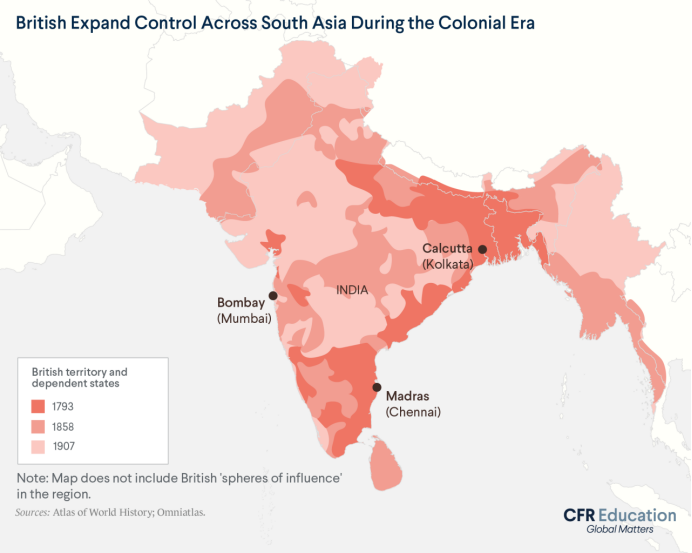
Britain’s vast global empire only began to break apart after World War II as the country faced massive debt and difficulties affording thousands of soldiers and administrators halfway around the world. Ultimately, the British departed the subcontinent in 1947 after dividing it into two newly independent countries: Hindu-majority India and Muslim-majority Pakistan. That division not only shaped many of the region’s present-day borders but also ushered in a deeply painful period of violence and displacement known as the Partition of India, during which millions of Muslims migrated to Pakistan and millions of Hindus and Sikhs fled to India. To this day, the trauma of partition fuels deep mistrust between India and Pakistan—two nuclear-armed countries.
Challenges and opportunities after independence
Centuries of foreign rule saw immense wealth leave India. Onerous regulations stunted its economic growth while other countries rapidly industrialized. And colonial agricultural policies contributed to the deaths of tens of millions of people in devastating famines.
But would India forever experience underdevelopment after gaining its independence from Britain? In short: no.
After 2021, the size of India’s economy surpassed the United Kingdom’s, and experts believe India’s economy will soon become the world’s third largest, trailing only the United States and China. High-quality information technology services such as data processing, information security, and communications have played a large role propelling economic growth.
I. Development Divide
Colonialism created a sharp development divide both between colonizers and colonized societies and within colonized territories themselves. The primary objective of colonial rule was economic extraction rather than equitable development. Colonies were structured to serve the interests of the imperial powers by supplying raw materials and providing markets for manufactured goods.
This economic arrangement distorted local economies. Traditional industries were often destroyed to prevent competition with European goods. For example, textile industries in India declined significantly under British rule due to the influx of machine-made British textiles. Agriculture was reorganized around cash crops such as cotton, sugar, rubber, and cocoa, leaving colonies vulnerable to global market fluctuations and food shortages.
Infrastructure development, often cited as evidence of colonial “progress,” was primarily designed to facilitate resource extraction. Railways and ports connected mines and plantations to shipping hubs rather than integrating domestic markets. As a result, economic growth was uneven and externally oriented.
Social divides were also intensified. Colonial administrations frequently employed divide-and-rule strategies, favoring certain ethnic or social groups over others to maintain control. This fostered long-term ethnic tensions and political instability. Education systems, where established, were limited and aimed at producing a small administrative elite rather than broad-based literacy.
The development divide extended into the post-colonial era. Former colonies inherited economies dependent on a narrow range of exports, weak industrial bases, and fragile institutions. Meanwhile, colonial powers accumulated wealth and industrial capacity, contributing to the global North-South divide that persists today.
II. Opportunities and Challenges
Despite its exploitative nature, colonialism did introduce certain changes that later provided opportunities for development. These included modern administrative systems, legal frameworks, transportation networks, and exposure to global trade. English, French, and Spanish became lingua francas that facilitated international communication and economic exchange.
Western-style education systems produced leaders who later spearheaded independence movements. In some regions, colonial rule reduced internal conflicts by centralizing authority and standardizing governance structures.
However, these opportunities came with significant challenges. Political systems were often authoritarian and excluded local participation. After independence, many states struggled to transition to democratic governance because colonial administrations had not encouraged political inclusivity.
Economically, colonies were locked into patterns of dependency. The lack of industrial diversification made post-colonial economies vulnerable to price shocks in global commodity markets. Socially, colonial rule disrupted indigenous cultures, languages, and knowledge systems. In settler colonies, indigenous populations experienced displacement, marginalization, and demographic collapse due to violence and disease.
Furthermore, artificial borders drawn by colonial powers ignored ethnic, linguistic, and cultural realities. These borders became sources of conflict after independence, contributing to civil wars and regional instability in parts of Africa and the Middle East.
Thus, while colonialism introduced structural changes that could be used for development, it also created systemic challenges that hindered sustainable growth and social cohesion.
III. Strategies for Balanced Development
To address colonial legacies, post-colonial nations must pursue strategies for balanced development that promote economic diversification, social inclusion, and institutional strengthening.
First, economic diversification is essential. Moving beyond dependence on primary commodities requires investment in manufacturing, technology, and service sectors. Governments must promote entrepreneurship, small and medium enterprises, and innovation to build resilient economies.
Second, inclusive governance is crucial. Strengthening democratic institutions, ensuring transparency, and promoting civic participation can counteract the authoritarian tendencies inherited from colonial rule.
Third, investment in human capital is fundamental. Expanding access to quality education, healthcare, and vocational training enables societies to overcome historical inequalities. Education systems should integrate indigenous knowledge and local histories to restore cultural identity.
Fourth, regional integration can reduce the fragmentation caused by colonial borders. Economic cooperation among neighboring countries enhances trade, infrastructure connectivity, and political stability.
Balanced development requires acknowledging historical injustices while focusing on forward-looking policies that empower communities and reduce structural dependence.
IV. Policy Frameworks and Historical Context
Understanding colonialism’s impact requires situating it within broader historical and policy frameworks. Colonial policies were shaped by mercantilism, industrial capitalism, and geopolitical competition. The primary aim was to secure economic and strategic advantage for the metropole.
Post-independence, many countries adopted import substitution industrialization (ISI) policies to reduce reliance on foreign goods. While ISI promoted domestic industries in some regions, it also led to inefficiencies and debt accumulation. Later, structural adjustment programs (SAPs) imposed by international financial institutions emphasized liberalization and privatization. Critics argue that SAPs often reinforced dependency and reduced public investment in social services.
Contemporary policy frameworks increasingly emphasize sustainable development, good governance, and poverty reduction. The United Nations Sustainable Development Goals (SDGs) encourage inclusive growth, environmental protection, and institutional accountability—objectives that address both colonial legacies and modern challenges.
Historical context reveals that development trajectories are shaped not only by colonial history but also by post-colonial leadership, global economic systems, and domestic policy choices. Recognizing this complexity prevents oversimplification of colonialism as solely responsible for present conditions, while still acknowledging its foundational impact.
V. Case Studies in Integrated Development
Examining specific countries highlights the varied outcomes of colonial legacies.
India inherited railways, civil services, and a legal system from British rule. While colonialism disrupted traditional industries and contributed to famines, post-independence India leveraged institutional frameworks to build a democratic system and diversify its economy. Today, India is a major global economy, though it continues to grapple with inequality and poverty rooted partly in colonial-era policies.
South Korea, colonized by Japan from 1910 to 1945, experienced harsh exploitation. However, Japanese investment in infrastructure and industry provided a base for post-war industrialization. Through strategic state-led policies, South Korea transformed into a high-income economy, demonstrating that effective governance can reshape colonial legacies.
Democratic Republic of Congo (DRC) illustrates a more destructive legacy. Under Belgian rule, resource extraction was brutal and development was minimal. After independence, weak institutions and conflict hindered growth despite abundant natural resources. The DRC’s struggles underscore how exploitative colonial systems can leave enduring instability.
These cases show that while colonialism created structural constraints, post-colonial leadership, policy decisions, and global contexts significantly influence development outcomes.
VI. Recommendations for Policy Prioritization
- To overcome colonial legacies, policymakers should prioritize:
- Economic diversification and industrial policy to reduce reliance on raw material exports.
- Institutional reform and anti-corruption measures to strengthen governance.
- Education reform that combines global knowledge with indigenous heritage.
- Regional cooperation frameworks to enhance trade and political stability.
- Equitable land and resource management policies to address historical injustices.
- Investment in infrastructure for domestic integration, not just export facilitation.
- Promotion of social cohesion programs to mitigate ethnic divisions intensified by colonial rule.
- These priorities should align with sustainable development principles, ensuring that economic growth does not come at the expense of environmental or social well-being.
Conclusion
Colonialism was neither purely developmental nor entirely destructive; it was a complex historical process with uneven consequences. While it introduced infrastructure, administrative systems, and global trade networks, its primary purpose was exploitation. The economic distortions, social divisions, cultural disruptions, and political instability it created have had long-lasting effects.
In many regions, the destructive consequences—resource extraction, dependency, inequality, and conflict—have outweighed the developmental gains. However, colonial legacies do not determine destiny. Post-colonial nations have demonstrated that strategic leadership, inclusive policies, and investment in human capital can transform inherited structures into foundations for growth.
Ultimately, the debate over colonialism should move beyond binary judgments. Instead, it should focus on understanding its historical impact and crafting policies that promote equitable, sustainable development. By addressing structural inequalities and fostering inclusive institutions, societies can overcome the shadows of colonialism and chart independent paths toward prosperity and justice.
Our group has reflected that our work for this activity is to support future students in Community Development programs as well as other current or potential community development workers around the globe. It will help others understand the course text: Development and Social Change: A Global Perspective with perspectives of how we see and understand it; that is our global perspective. This textbook was written from a white male perspective. It would be interesting to have it rewritten from the perspective of people of colour who have lived experiences of their own. These individuals’ lived-experiences more than make up for a more global perspective as compared to just being viewed from a white male perspective.
Our work will be limited, however, by having the perspective of someone from the Community Development Work program. Our viewpoints will differ from those of the Indigenous Studies program, Historical Studies program, and other such programs. Our viewpoints, be them diverse, are still just how we understand the topic by applying Community Development Work principles. There is still a greater need for everyone to be critical of everything we read on the internet, and we should also validate our sources and do research work effectively.