
Introduction
An in-depth study of Social Reforms is integral to Sociology of Indian Society; Similarly, Industrial Relations constitutes the bulk
of Industrial Sociology. Among all the Indian Freedom Fighters, Netaji Subhas Chandra Bose‟s ranking concerning his contribution to Indian freedom
struggle and popularity is next only to Mahatma Gandhi.
Historians, military strategists, anti-colonialists and political scientists have had the veteran revolutionary as a subject of serious academic discussions. The towering charisma of Netaji Subhas Chandra Bose as a military leader at the forefront of IndianIndependence movement (particularly outside India) has dwarfed many of his other contributions-especially as a Social Reformer and
Industrial Relations Expert. Netaji Subhas Chandra Bose was a great orator, prolific writer and a doer – one who practised what he preached. Though Netaji has never been a student of Sociology, he was always a keen observer of Indian Society. During his stay in Europe Netaji did establish and develop contacts with Sociologists apart from political leaders, Economists, literati, scientists and people from the cultural world. Netaji Subhas Chandra Bose‟s ideas, writings, and actionsprovide enough material for serious Sociological research, especially in the field of Sociology of Indian Social Reforms and Sociology of Indian Industrial Relations. The principal objective of this paper is to highlight the
contributions of Netaji Subhas Chandra Bose to Social Reforms in India and Indian Industrial Relations-primarily as an Outside Trade Union Leader and Champion of Labour Welfare and to argue for a serious study of the Revolutionary through the
Sociological and Industrial Relations viewpoint. Apart from the speeches delivered by Netaji Subhas Chandra Bose and official letters and special (Military) orders written by him during his illustrious public life in various capacities, secondary
sources have formed a bulk of the data in this paper to give us a better understanding of the issue at hand. Some of the positions Bose held were the President of the Indian National Congress, Mayor of Calcutta, President of TATA Steel Workers Union & All India Trade Union Congress-AITUC, Head of the Provisional Government of Free India and Supreme Commander of the Indian
National Army. Besides the use of Secondary sources, some datain connection with Netaji Subhas Chandra Bose andSocial Reforms has also been gathered via expert interviews of ex -Indian National Army (INA)and Azad Hind Dal Personnel. These interviews will serve as a part of our primary data.
Subhas Chandra Bose stands as one of the most dynamic and controversial figures in the history of Indian nationalism. Revered as “Netaji,” Bose represented a radical, militant, and internationalist strand within India’s struggle for independence. While leaders like Mahatma Gandhi emphasized non-violence and civil disobedience, Bose advocated armed resistance and strategic international alliances to overthrow British colonial rule. His leadership of the Indian National Army (INA), his role in the Indian National Congress, and the establishment of the Provisional Government of Free India marked a transformative phase in the freedom struggle.
Bose’s contribution to Indian nationalism cannot be understood merely as military adventurism. Rather, it involved reimagining nationalism as a total mobilization of political will, economic planning, social unity, and global diplomacy. His ideas addressed deep developmental divides within Indian society, sought to create opportunities for integrated national development, and presented a distinct policy vision for post-independence India. This essay examines Bose’s contribution through multiple lenses: historical context, development divides, opportunities and challenges, strategic balancing, policy frameworks, case studies, and contemporary policy relevance.
Subhash Chandra Bose, Education, Role in Freedom Struggle
Subhash Chandra Bose was a key figure in India’s fight for freedom from British rule. Check about Subhash Chandra Bose Education, Role in Freedom Struggle, Legacy.
Subhash Chandra Bose was a key figure in India’s fight for freedom from British rule during the early to mid-20th century. In 1943, Subhash Chandra Bose founded the Indian National Army (INA) i.e. Azad Hind Fauj, and led an armed coup, inspiring thousands of Indian youths to fight for independence from British colonialism. Subhash Chandra Bose was completely committed to the cause of overthrowing British dominance, convinced that national freedom was critical for India’s future.
Subhash Chandra Bose’s political ideas demonstrated his unwavering commitment to independence and his willingness to explore various strategies to achieve it. His famous slogan was “Give me your blood, and I shall give you freedom”. Subhash Chandra Bose continues to be a symbol of assertive nationalism.
Subhash Chandra Bose Biography
Subhash Chandra Bose was born on January 23, 1897, in Cuttack, then part of the Bengal Presidency, to Bengali parents Prabhabati Dutt and Janakinath Bose.
Education: Bose was admitted to the Protestant European School in Cuttack and then shifted to the Ravenshaw Collegiate School. In 1916, he was expelled from Presidency College in Kolkata due to his nationalist activities.
Civil Services: Later, Bose attended the University of Cambridge and passed the Indian Civil Services (ICS) exam in 1920. However, due to the Jallianwalla Bagh massacre, he left his high-paying job and returned to India from England in 1921.
Inspired by Vivekananda: Inspired by Swami Vivekananda and mentored by Chittaranjan Das, Bose became deeply involved in India’s independence movement.
Membership of INC: Bose joined the Indian National Congress (INC), emerging as a prominent leader in the struggle against British colonialism.
Subhash Chandra Bose – Role in Freedom Struggle
Subhash Chandra Bose, a prominent figure in India’s freedom struggle, is known for his revolutionary approach and his role in forming the Indian National Army (INA) to fight against British rule, Formation of the Forward Bloc, a Provisional Government for free India and gave slogans like “Delhi Chalo” and “Jai Hind”.
Subhash Chandra Bose and Indian National Congress
Subhash Chandra Bose’s deep involvement in nationalist politics began under the mentorship of Chittaranjan Das. For nearly two decades (from 1921 to 1940) Bose actively worked within the Indian National Congress (INC), striving to shape its direction and influence its strategies for India’s freedom struggle.
Joined INC in 1921: Subhash Chandra Bose joined the INC in 1921, inspired by political disturbances, and was directed by Mahatma Gandhi to Chittaranjan Das, a key nationalist leader in Bengal.
Newspapers: In 1921, Bose became the editor of Forward, a newspaper of the Swaraj Party, and in 1922, he launched the newspaper Swaraj.
Participation in NCM: Bose was arrested alongside Chittaranjan Das in December 1921 for participating in the Non-Cooperation Movement (NCM).
Role as Youth Leader: In 1923, Subhash Chandra Bose was elected President of the All India Youth Congress and Secretary of the Bengal State Congress and later served as Chief Executive Officer of Calcutta under Mayor Chittaranjan Das.
Advocated Poorna Swaraj: Bose rejected Dominion Status (Nehru Report) in 1928, co-founded the “Independence for India League,” and strongly advocated for Poorna Swaraj (complete independence) alongside Jawaharlal Nehru.
Book: Subhas Bose wrote The Indian Struggle, covering the independence movement from 1920 to 1934, which was published in 1935 but banned in British colonies for fear of unrest.
Congress President: Subhash Chandra Bose was unanimously elected Congress President at the Haripura session in 1938 and re-elected in 1939 at the Tripuri session.
At Haripura Session Bose advocated for economic development through planning and establishing a National Planning Committee.
Subhash Chandra Bose Relationship with Gandhi
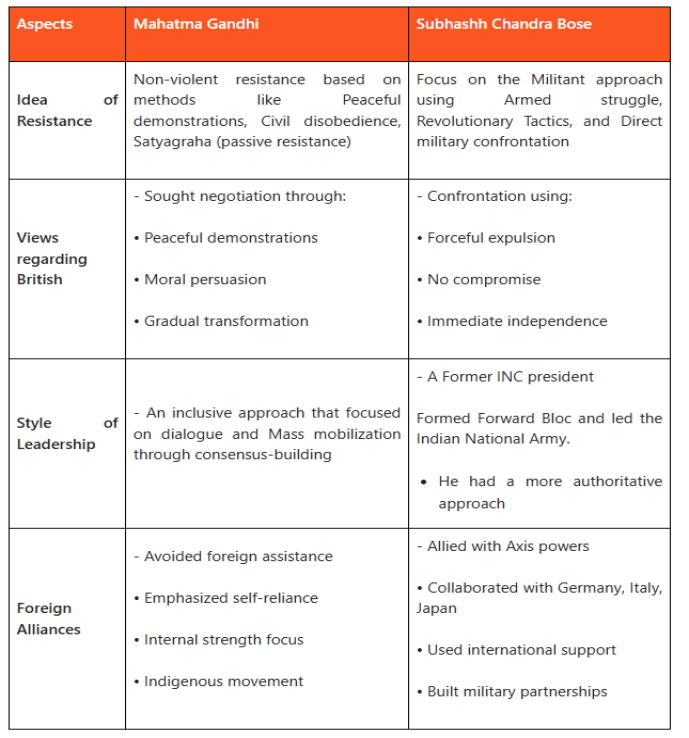
Subhash Chandra Bose and Mahatma Gandhi, despite their ideological differences, had mutual admiration. Gandhi called Bose the “Prince among Patriots” in 1942, while Bose referred to him as the “Father of Our Nation” during the 1944 broadcast from Rangoon.
Ideas of Resistance: Although their political approaches diverged, Bose believed in forceful resistance while Gandhi adhered to non-violence.
Common Ideals: Bose deeply valued Gandhi’s contributions, stating his name would be remembered in “letters of gold” in India’s history. Both leaders shared common ideals such as fighting untouchability and advocating women’s emancipation.
The Key differences in the approach of Subhash Chandra Bose and Mahatma Gandhi in the struggle for freedom are discussed in the table below:
Subhash Chandra Bose Forward Bloc
Subhash Chandra Bose resigned as President of the Indian National Congress in 1939, disillusioned with its approach, following the Tripuri Congress session. He later founded the Forward Bloc in May 1939 to advocate for immediate independence through assertive action.
Forward Bloc: It sought to bring together all radical elements of the Congress Party. Forward Bloc aimed to promote India’s independence while upholding equality and social justice.
Subhash Chandra Bose Escape to Germany
Subhash Chandra Bose held the Anti-Compromise Conference in March 1940, protesting British imperialism, and was later arrested but escaped house arrest in January 1941, travelling to Peshawar under the alias Ziauddin.
Formation of Freedom Army: Bose reached Germany, met Hitler, and formed the Freedom Army (Mukti Sena) from Indian Prisoners of War (POWs) while establishing Dresden as its headquarters and popularizing the slogan “Jai Hind.” from the Free India Centre in Germany.
The Mukti Sena soldiers first referred to Bose as Neta Ji.
Radio Broadcasts from Germany: Bose also inspired Indians through radio broadcasts from Berlin in 1942, and later travelled to Japan and Singapore in early 1943 using German and Japanese submarines to continue his struggle.
Subhash Chandra Bose Indian National Army
Subhash Chandra Bose reformed the Indian National Army (INA), also known as the Azad Hind Fauj. The INA was initially formed by Mohan Singh in 1942 with support from Japan, recruiting around 40,000 Indian Prisoners of War (POWs). Subhash Chandra Bose took command of the INA in July 1943 in Singapore, reorganized it, and established the Provisional Government of Free India, which declared war on Britain and the U.S. and was recognized by Axis powers.
Women Brigade: Bose formed the Rani Jhansi Regiment, a women’s unit led by Captain Lakshmi Swaminathan, reflecting his vision of women’s empowerment in the independence struggle.
Success in Andaman: In December 1943, INA freed the Andaman and Nicobar Islands from the British which were renamed Swaraj and Shaheed Islands.
Headquartered in Rangoon: In January 1944, the INA headquarters moved to Rangoon (Burma), where army recruits were set to march with the war cry “Chalo Delhi!”.
Impact of World War II: The INA advanced into India in April 1944, raising the flag in Moirang, but was forced to retreat as Japanese forces withdrew with Japan’s surrender in World War II in 1945.
Subhash Chandra Bose – Role in Freedom Struggle Legacy
Subhash Chandra Bose is celebrated as a national hero in India for his resistance against British rule. January 23 is declared Parakram Divas to honour his birth anniversary. His actions not only inspired the Indian populace but also resonated globally, fueling independence movements worldwide. The enduring impact of Bose’s vision and tireless efforts was evident in 1947 when India gained its long-awaited independence.
His famous quote, “In this mortal world everything perishes and will perish, but the ideas, ideals, and dreams do not,” encapsulates the profound legacy he left behind, one that continues to inspire generations..
NetajiSubhas Chandra Bose and Indian Industrial Relations
During his eventful years in India, before his great escape from
house arrest and subsequent departure to Europe and then to
South East Asia, Netaji Subhas Chandra Bose was very closely
associated with Indian Industrial Relations. His writings and
activities in this field provide sufficient material for research in
Industrial Sociology/Sociology of Industrial Relations. Among the
top Indian Nationalist Leaders, the contributions of Netaji to
Industrial Relations in India is next only to Mahatma Gandhi.
Sociology of Indian Industrial Relations is blessed with a large
quantity of data about various facets of Industrial Relations
contributed by Netaji as an outstanding Industrial Relations expert.
Like Mahatma Gandhi, Netaji too had a clear understanding and
views on Indian Industrial Relations. Mahatma Gandhi‟s approach
to Industrial Relations is popularly known as the Trusteeship
Approach. We can seriously think of a „Subhashite Approach‟ to
Industrial Relations. His views, writing, and actions about
Industrial Relations will be of much interest to students of
Industrial Sociology and Industrial Relations.
Netaji‟s first association with Indian Industrial Relations was in the
year 1922 when his political mentor and veteran Indian Nationalist
Desh Bandhu Chittaranjan Das got him associated with the Lahore
Trade Union Congress. His contributions to Indian Industrial
Relations is a direct result of his association with the Indian
working class and their trade unions, especially as the Outside
Trade Union Leader [President] of Jamshedpur Labour Association,
Tinplate Workers Union, and TISCO Worker‟s Union. He was
elected President of India‟s first Central Trade Union Federation,
the All India Trade Union Congress (AITUC) in 1931 there by
emerging as the most important Trade Union Leader of not only
British India but also in the entire British Colonial Empire.
Subhash Chandra Bose was a fearless nationalist whose uncompromising pursuit of India’s freedom made him a prominent leader of the independence movement. His efforts to organise the Indian National Army and seek international alliances showcased his revolutionary approach to achieving complete independence. This article aims to study in detail Bose’s ideologies, leadership, and his enduring legacy in India’s struggle for freedom.
About Subhash Chandra Bose
Subhash Chandra Bose, born on January 23, 1897, in Cuttack, Odisha, was a revolutionary patriot whose vision and determination played a critical role in India’s fight for independence.
Known for his radical approach, dynamic leadership, and unwavering commitment to India’s freedom, Bose left an indelible mark on Indian history.
Often referred to as Netaji (respected leader), he believed in achieving complete independence through decisive action, even if it meant adopting armed struggle.
Early Life and Influences
Bose’s early years were marked by academic excellence and a keen sense of patriotism, significantly influenced by Swami Vivekananda’s teachings.
He completed his education at the prestigious Presidency College in Kolkata and later at the University of Cambridge, where he cleared the Indian Civil Service Examination in 1920.
However, Bose resigned from the coveted position, driven by his commitment to join the Indian independence movement.
He regarded Chittaranjan Das as his political mentor and Swami Vivekananda as his spiritual guide, who shaped his political ideology and deep sense of social responsibility.
Ideological Vision of Subhash Chandra Bose
Nationalism and Socialism
Bose’s ideology was rooted in the principles of nationalism, socialism, and leftist thought:
Complete Independence: Unlike many leaders of his time, Bose insisted on achieving Purna Swaraj (complete independence) rather than settling for dominion status.
Socialist Vision: He envisioned an industrialised and modernised India, advocating state ownership of major industries and economic planning.
Secularism: Bose upheld a secular vision, emphasising unity beyond religion, caste, or region.
Militant Approach: Disenchanted with Gandhi’s strategy of non-violence, Bose believed in armed resistance as a viable path to freedom.
Political Journey
Role in Congress
Bose joined the Indian National Congress and quickly rose to prominence:
Elected President of the Youth Wing of the Congress.
Became Congress President in 1938 and 1939, steering the party towards a more radical stance on independence.
Differences with Mahatma Gandhi over achieving independence led to his resignation in 1939 and the subsequent formation of the Forward Bloc.
Formation of the Indian National Army (INA)
During World War II, Bose sought alliances with Axis powers, leveraging the global conflict to challenge British rule in India.
In 1942, Bose formed the Indian National Army (INA) with the support of Japan, revitalising it with captured Indian soldiers.
The INA was an inclusive force with soldiers from diverse regions, religions, and ethnicities, including women.
Slogans like “Jai Hind,” “Give me blood, and I will give you freedom,” and “Dilli Chalo” became rallying cries for the freedom movement.
Key Contributions of Subhash Chandra Bose
Revitalizing the Independence Movement
Bose’s leadership inspired a more militant approach to independence, balancing the movement’s moderate and extremist ideologies.
His advocacy for immediate and uncompromising independence galvanised younger leaders and freedom fighters.
International Alliances
Bose’s collaboration with Axis powers showcased his strategic acumen, though it sparked controversy due to ethical concerns about partnering with regimes like Nazi Germany and Imperial Japan.
The INA’s campaigns, though militarily unsuccessful, significantly undermined British morale and paved the way for the eventual withdrawal of colonial rule.
Role of Subhash Chandra Bose in Freedom Struggle
Subhash Chandra Bose was a charismatic leader who played a significant role in India’s freedom struggle by advocating for complete independence and rejecting British dominion status.
He founded the Forward Bloc and revitalized the independence movement with his militant approach.
Bose is best known for leading the Indian National Army (INA) and forming the Azad Hind Government in exile, rallying Indian expatriates and prisoners of war to fight against British rule.
His slogan, “Give me blood, and I will give you freedom,” inspired millions, and his relentless pursuit of liberation left an indelible mark on India’s struggle for independence.
Ideology of Subhash Chandra Bose
The ideology of Subhash Chandra Bose was centred on nationalism, self-reliance, and militant resistance to colonial rule.
He believed in achieving complete independence through force, if necessary, diverging from Gandhi’s nonviolent methods.
Bose advocated for a strong, authoritarian state to rebuild India and emphasised the importance of socialism for economic equality and social justice.
His vision was inclusive, seeking unity among all religions, castes, and regions to create a cohesive national identity.
Bose also prioritised mobilising youth and fostering international alliances, especially with countries opposed to British imperialism, to achieve India’s liberation.
Ideological Differences: Subhash Chandra Bose vs. Mahatma Gandhi
The contrasting ideologies of Bose and Gandhi reflected the diversity of approaches within the freedom movement.
| Dimension | Mahatma Gandhi | Subhash Chandra Bose |
| Ideological Basis | Advocated non-violence (Ahimsa) and moral purity through Satyagraha. | Believed in political violence and armed resistance for independence. |
| Religion in Politics | Integrated religious values into political life; prayers often had political messages. | Advocated secularism, separating religion from politics. |
| Economic Vision | Supported village-centric, labour-intensive economies; opposed industrialisation. | Envisioned industrialisation and a modernized, state-controlled economy. |
| Response to British | Favoured truce and negotiation, including Dominion Status in early years. | Advocated for Purna Swaraj from the outset; opposed concessions. |
| Approach to Movements | Suspended Non-Cooperation Movement after Chauri Chaura incident. | Criticised the suspension as premature and harmful to momentum. |
| State and Governance | Opposed modern state machinery, favouring decentralised governance. | Favoured a robust and centralised state modelled on Soviet-style socialism. |
Legacy of Subhash Chandra Bose
Bose’s efforts to foster unity among Indians of all backgrounds left a legacy of inclusivity, exemplified by the INA’s diverse composition.
His advocacy for industrialisation and state planning influenced India’s post-independence economic policies, particularly under Nehru’s leadership.
Bose’s life and ideals inspire Indians, with his slogans and philosophy serving as enduring symbols of courage and determination.
I. Development Divide
- Colonial India suffered severe developmental divides:
- Rural vs. urban disparities.
- Industrial stagnation.
- Poverty and illiteracy.
- Communal fragmentation.
- Regional inequalities.
British economic policies deindustrialized traditional sectors and prioritized extraction of raw materials. Bose viewed political independence as inseparable from economic reconstruction. He recognized that nationalism must address socio-economic disparities to sustain unity.
Unlike purely political nationalists, Bose integrated social justice into his vision. He supported labor rights, state intervention in industry, and scientific progress. He advocated planned economic development, anticipating later initiatives such as India’s Five-Year Plans.
Furthermore, Bose promoted communal harmony. His INA included Hindus, Muslims, Sikhs, and Christians fighting under a common national flag. Slogans like “Jai Hind” symbolized inclusive nationalism beyond religious identities.
II. Opportunities and Challenges
Opportunities
- World War II Context: The outbreak of the war weakened Britain. Bose saw it as an opportunity to internationalize India’s struggle.
- Diaspora Mobilization: Indian expatriates in Southeast Asia provided manpower and resources for the INA.
- Rising Mass Consciousness: Civil disobedience movements had already awakened political awareness.
Challenges
- Ideological Opposition: Gandhi and Congress leadership opposed Bose’s methods.
- Colonial Surveillance: Bose was repeatedly imprisoned and eventually placed under house arrest.
- International Alliances: Seeking support from Axis powers such as Adolf Hitler and Hideki Tojo posed moral and diplomatic dilemmas.
- Military Constraints: The INA faced logistical and strategic limitations.
Bose’s daring escape from India in 1941, his travels through Afghanistan and Germany, and later leadership in Japanese-occupied Southeast Asia demonstrated extraordinary commitment. However, reliance on Axis powers complicated his legacy.
III. Strategies for Balanced Development
Bose believed political freedom was incomplete without socio-economic transformation. His strategies included:
1. Centralized Economic Planning
As Congress President in 1938, he established the National Planning Committee under Jawaharlal Nehru. Though Bose and Nehru differed ideologically, both agreed on industrialization.
2. Military Nationalism
Through the Indian National Army, Bose sought to instill discipline and unity. The Rani of Jhansi Regiment, an all-women combat unit, symbolized gender empowerment.
3. Secular Integration
The Provisional Government of Free India represented all communities. Bose emphasized equality regardless of religion or caste.
4. Social Mobilization
He called for total mobilization—economic, social, and psychological—against colonial rule. His famous slogan, “Give me blood, and I shall give you freedom,” underscored collective sacrifice.
These strategies attempted to balance political radicalism with long-term developmental vision.
IV. Policy Frameworks and Historical Context
The late nineteenth and early twentieth centuries witnessed the consolidation of British colonial power in India. The partition of Bengal in 1905, economic exploitation under colonial policies, and racial discrimination fostered nationalist sentiment. Organizations like the Indian National Congress initially adopted moderate methods, seeking constitutional reforms.
Bose emerged in this context as a young intellectual influenced by Swami Vivekananda’s spiritual nationalism and European political thought. After qualifying for the Indian Civil Service, he resigned in 1921, symbolizing rejection of colonial authority. His early political career was shaped under the mentorship of Chittaranjan Das.
By the 1930s, ideological differences within Congress intensified. Bose was elected President of Congress in 1938 and again in 1939 at the Tripuri session, defeating Gandhi’s preferred candidate. However, his radical approach, advocating immediate independence and mass mobilization against British rule, clashed with the Gandhian strategy. Eventually, Bose resigned and formed the Forward Bloc to consolidate left-wing forces.
His policy framework emphasized:
- Strong centralized planning.
- Industrial modernization.
- Social and economic equality.
- Secular and inclusive nationalism.
- Military preparedness as a pillar of sovereignty.
This framework differed from Gandhi’s decentralized, village-centric model. Bose admired aspects of European state planning and believed India required disciplined organization to overcome colonial underdevelopment.
V. Case Studies in Integrated Development
Case Study 1: The Indian National Army
The Indian National Army became a practical embodiment of Bose’s inclusive nationalism. Soldiers from diverse backgrounds united under a common cause. Though militarily defeated during campaigns in Imphal and Kohima, the INA trials in 1945 ignited nationwide sympathy and unrest.
The Red Fort trials of INA officers galvanized public opinion, including among soldiers in the British Indian Army. Many historians argue that the INA’s impact hastened British withdrawal by undermining loyalty within colonial forces.
Case Study 2: Provisional Government of Free India
Established in 1943 in Singapore, the Provisional Government of Free India declared war on Britain and sought international recognition. Though largely symbolic, it demonstrated Bose’s attempt to create parallel sovereignty structures.
The government issued currency, stamps, and maintained diplomatic missions. This reflected a comprehensive vision of statehood rather than mere rebellion.
VI. Recommendations for Policy Prioritization
- Bose’s ideas remain relevant in contemporary India. Policy prioritization inspired by his thought may include:
- Strong National Unity: Promote inclusive nationalism transcending communal divides.
- Strategic Autonomy: Maintain independent foreign policy rooted in national interest.
- Industrial and Technological Advancement: Continue emphasis on self-reliance and modernization.
- Defense Preparedness: Ensure military strength as a safeguard of sovereignty.
- Gender Empowerment: Expand women’s participation in defense and governance.
- Planned Economic Growth: Balance market reforms with state intervention for equity.
- His approach suggests that development and nationalism must reinforce each other.
Conclusion
This paper has been written primarily to highlight the lesser discussed ideas and contributions of the Nationalist Revolutionary Netaji Subhas Chandra Bose. Many of his ideas and efforts inconnection with Social Reforms and Industrial Relations stand the test of time. Many of his actions as Head of State & Supreme
Commander of INA, has trickled down to institutions Free India. Mahatma Gandhi and Netaji Subhas Chandra Bose were two Indian Nationalists who were also concerned with social reforms and Labour Rights. Mahatma Gandhi had clearly stated that an entrepreneur has no right to be in business if he cannot pay his
workers at least minimum wages. Netaji‟s views regarding wages were a step further. He was for the payment of highest wages Living Wages to labour. He had argued for the same a decade before India‟s Independence and the establishment of the Republic. He was also for workers‟ participation in management. It is very
interesting to note that the makers of the Constitution of The Republic of India gave importance to the same. Living wages for workers and Participation of workers in management of industries were incorporated under Part IV-Directive Principles of State Policy, Article 43 and Article 43-A respectively. Many Indian Public Sector Industries and few Private Sector Industries have indeed incorporated the Workers Participation in Industries through Joint Councils, Joint Management Councils, Worker-Directors, etc. Though, unfortunately, the INA personnel were not inductedinto Free India‟s Armed Forces, the high secular credentials established by Netaji Subhas Chandra Bose in INA has been infused into the three wings of Indian Armed Forces, giving it the honour of being the world‟s most secular Defence Forces.Netaji laid the foundation for incorporation of Ladies into the armed forces. Free India‟s armed forces have also extended the tradition. Netaji was a leader with Left leaning ideology and founder of a Leftist Political Party – The Forward Bloc, who fully understood the spiritual nature of Indian Society, and thus never negated spirituality. Very interestingly, The Communist Party of India and The Communist Party of India (Marxist), with their strong grounding in atheism, of late seems to agree with Bose on this count and have taken a relaxed stand with regard to its members(including MLAs and MPs) who would like to profess their faith. The Communist Parties have also accepted that they made a mistake in wrongly accusing Bose for seeking German and Italian help in ousting the British. His arguments for outside leadership to some extent in Trade Unions,anti-imperialistic stand, etc. are very relevant to this day. He had
insisted on workers/Trade Unions‟ role in National Integration and the same finds mention in the report of the First National Commission of Labour. No doubt, students of Sociology in India, especially Sociology of Social Reforms, Sociology of Industrial Relations and even Military Sociology will find a treasure of sorts for Sociological research in the writings of Netaji and various writings on Netaji. Academicians in the discipline of Sociology and Industrial Relations can seriously
think of introducing „efforts of Netaji Subhas Chandra Bose as a Social Reformer and pro-labour Industrial Relations Crusader‟ and include his published speeches and other secondary sources as Study material/reference material in their syllabi. From the recently declassified (and yet to be declassified) Netaji Files, apart
from the mystery‟ surrounding his disappearance and associated conspiracy, much can be gathered about his powerful role in social reforms and Industrial Relations. A serious academic interest and study of Netaji Subhas Chandra Bose‟s contributions to various academic fields including Sociology and Industrial Relations, itself will no doubt be a fitting tribute to the self-sacrificing, selfless
revolutionary nationalist reformer.
Subhas Chandra Bose contributed to Indian nationalism by injecting it with urgency, militancy, and global perspective. He challenged the dominant paradigm within the freedom movement, expanded its strategic horizons, and emphasized the inseparability of political independence and socio-economic transformation.
Though controversial for his alliances during World War II, Bose’s legacy transcends these debates. The INA’s impact on colonial morale, the inclusive spirit of Azad Hind, and his emphasis on planning and modernization shaped India’s nationalist imagination.
Indian nationalism was not monolithic; it was a mosaic of ideologies and strategies. Bose represented its revolutionary edge—unyielding, visionary, and deeply committed to complete independence. His life illustrates that nationalism can be both a struggle for political sovereignty and a blueprint for integrated national development.
In the broader narrative of India’s freedom struggle, Bose remains a symbol of courage, sacrifice, and uncompromising patriotism. His call for unity, discipline, and social justice continues to resonate, reminding future generations that freedom demands both vision and action.