

Introduction
India’s population growth has been one of the most defining forces shaping the country’s social and economic trajectory. From a population of about 361 million at independence in 1947 to over 1.4 billion in the 21st century, India has undergone a profound demographic transformation. In 2023, India surpassed China to become the world’s most populous nation, marking a historic milestone in global demography. This rapid population expansion has brought both significant opportunities and formidable challenges. While a large and youthful population can serve as a demographic dividend that fuels economic growth, it can also strain resources, infrastructure, and public services if not managed effectively.
The social and economic implications of India’s population growth are complex and multifaceted. They influence employment patterns, urbanization trends, environmental sustainability, healthcare systems, education infrastructure, and social equity. Understanding these implications requires examining historical population trends, regional disparities, policy responses, and case studies of integrated development. This essay explores these dimensions, analyzing how India can leverage its demographic potential while mitigating the risks associated with rapid population growth.
The Population Time Bomb: Impact on National Integration
Population dynamics have an impact on a country’s economic and strategic capabilities. Sparsely populated countries may face strategic challenges, but large populations are not necessarily a blessing. An unbridled population growth can greatly hinder the development process, besides adversely impacting on the environment.
An article published in 2011,[i] on the implications and trends of India’s demographic outlook, came out with estimates of what India’s demography will look like in 2030. The article stated that as per UNDP projections, India’s population will exceed China’s by 2025, and that the crossover will in all probability occur well before that time, making India the most populous country in the world. This article was extremely prescient in its predictions, as India is set to overtake China’s population sometime in 2023, but more ominously, the article has predicted that India’s population by 2030 will be in the region of 1.5 billion people. Is this sustainable and can India afford to go down that path? What are the fissiparous tendencies that such a growth can have on Indian society? These questions need to be asked and more importantly, need to be addressed with urgency.
Population Growth over the last five decades: World Comparison
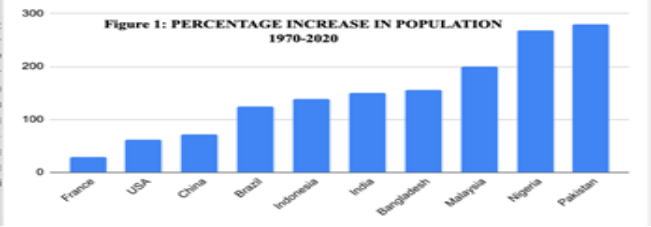
How has the world’s population increased over the last five decades? Statistics from 1970 onwards indicate that the Western world has successfully kept a lid on population growth. China too has been remarkably successful in controlling its population. However, most Asian and African countries have seen unprecedented population growth, which has hindered economic growth, created vast disparities between different economic groups, created water stress and food scarcity and led to fissures in society. All of these factors combined together have led to dismal standards of living for vast multitudes of people across the globe. The percentage increase in population over the last half-century for 10 countries is given in Figure 1.[ii]
The decadal growth rate of population also makes an interesting study (Figures 2 and 3).[iii] Both the US and France, over the last half-century, have had a decadal growth of population below 10 percent for the period 1970-2020. This is true for most of the Western world. Low population growth has been a contributory factor to their ability to provide a high standard of living to their people and being classified as first-world countries. China, which imposed a one-child policy on its populace in September 1980 saw only a marginal decline in population growth for the first decade after the policy was introduced. The decade 1970-1980, prior to the introduction of the policy saw a decadal increase in the population of 20.8 percent. In the first decade after the implementation of the one-child policy (1980-1990), there was but a marginal decline, with decadal population growth at 17.7 percent. This indicates that the one-child policy was widely flouted by most residents. The next two decades saw decadal population growth dropping to below 10 percent, and for the decade 2010-2020, the population growth was just 5 percent. This is comparable to the population growth in France, which saw a decadal population growth hovering between 4 to 6 percent for the five decades 1970-2020. The US has also maintained for the most part, decadal population growth under 10 percent for the last five decades.
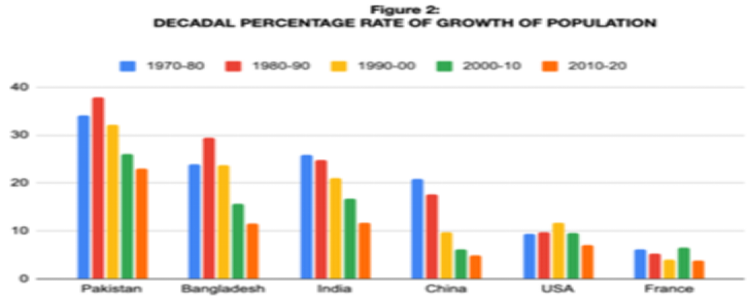
In the Asian subcontinent, the situation has unfortunately spiralled out of control. In Pakistan, the decadal population growth has been in excess of 30 percent for each of the three decades 1970-2000. A marginal decrease has taken place post-2000, with decadal population growth reducing to 26 percent and 23 percent for the decades 2000-2010 and 2010-2020 respectively. In real terms, the population of Pakistan has increased 3.8 times in the last half-century (1970-2020) and about seven times since the country achieved independence in 1947. This is clearly unsustainable. Bangladesh also has high decadal population growth, though their performance is far better than Pakistan. For the period 1970-1980, decadal population growth was 24 percent. This rose to 29.5 percent in the decade 1980-1990, which indicates that in the earlier decade following the Liberation War, large-scale migration of population had taken place from Bangladesh to India. Thereafter, decadal population growth witnessed a slight decline with population growth at 24 percent. Since then, population control measures appear to have been more successful, with decadal population growth at 15.6 percent and 11.5 percent for the period 2000-2010 and 2010-2020 respectively.
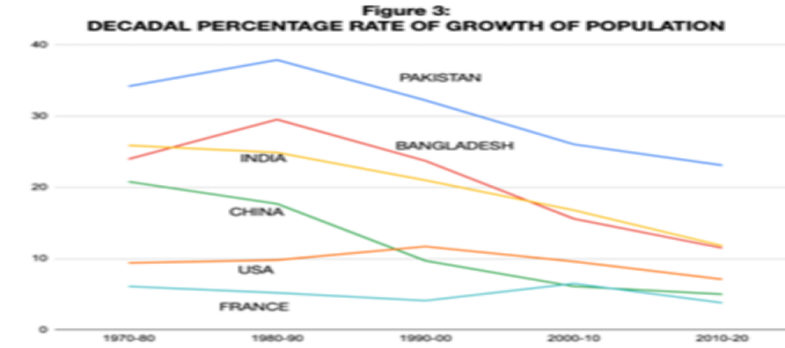
The statistics for India too are not very flattering and resemble to some extent the statistics of Bangladesh. The three decades 1970-2000 saw the decadal population growth hover between 26 percent and 21 percent. This is high and reflects a failure of the nation’s family planning programme. The decadal population growth dropped below 20 percent for the next two decades, touching 16.8 percent in 2000-2010 and falling further to 11.8 percent for the decade 2010-2020. This is still high though it now appears that India is closer to getting to grips with the problem. What remains of serious concern, however, is the wide variation in population growth between different parts of the country as also between different communities, which potentially can cause severe fissures in Indian society.
India and China: A Statistical Analysis
At times, when development or rather the lack of it is linked to excessive population growth, the nay-sayers promptly state that poor economic development is not due to unbridled population growth but due to socio-economic factors. Then they justify their assumption by giving a reference to China, quoting its spectacular economic growth despite it being the most populous country in the world. This is simply intellectually dishonest. Undoubtedly, poor socio-economic policies hinder economic growth, but unbridled population growth negates even the most pragmatic of economic policies and will invariably result in weakening poverty alleviation programmes. China’s spectacular rise is a result of strict measures to restrict family size; had such measures not been taken, the picture in China would have been rather gloomy.
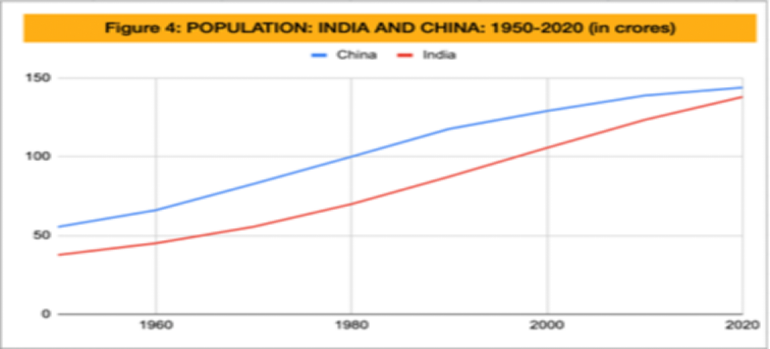
A comparison of population data between India and China—the world’s two most populous countries is indeed instructive. Figure 4[iv] shows the population of India and China from 1950 till 2020. China’s population, which stood at 55.44 crore in 1950 had almost doubled over the course of the next three decades to 100 crore by 1980. This was when China began its family planning programme, with its one-child policy. In 2020, 40 years later, China’s population stood at 143.93 crore, an increase of just under 44 percent. In comparison, for the period 1950-1980, China’s population had increased a whopping 80 percent. Had China continued with such a high rate of population growth, it would have crossed the two billion level mark by now (figure 5). What would be the impact on China if it had another 600 million mouths to feed and look after, can only be speculated, but undoubtedly, China would have still been a third-world country. As of now, while China’s decadal population growth has reduced to single digits, it is still higher than most European countries.
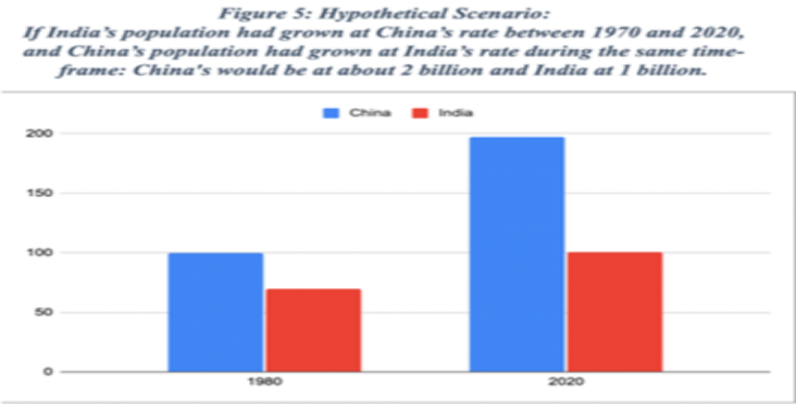
Now let us take a look at India. India’s population stood at 37.63 crore in 1950. In terms of comparison, this is less than the present-day combined population of Pakistan and Bangladesh. By 1980, India’s population had surged to 69.89 crore, indicating a growth of 85 percent. At this stage, India’s and China’s rate of population growth were almost similar. Over the next 40 years, the situation changed dramatically. In 2020, India’s population stood at 138 crore, an increase of a staggering 97 percent! Had India been successful in controlling its population as China had done, its present population would have been just over one billion (Figure 5). With 400 million less people, unemployment in India would have been minimal, the cities would not be bursting, pollution levels would have been under control and in all likelihood, India would have been a middle-income country.
Population Dynamics: Internal Fissures
The population growth of India is an area of concern, but more ominous is the fact that this population growth is uneven and could potentially create serious fissures in society on two counts. The first is related to a Constitutional provision. Article 81 of the Indian Constitution lays down the distribution of seats to each state based on their population, while Article 82 provides for the readjustment of seats in the Lower House, after each census. This delimitation was suspended in 1976 till the 2001 census, primarily because the Southern states had achieved a higher degree of population control than the states in the North. This was again postponed to 2026 by the 84th Amendment. In the revised allocation, the Northern states would have got a larger share than the South,[v] which effectively meant rewarding those states that were less effective in promoting small family norms.
Let us take the example of five northern states and five southern states to put the above issue in perspective. Based on population data, the Northern parts of the country have shown a higher rate of decadal population growth as compared to the Southern states which have achieved a certain measure of population stability. A readjustment of seats, carried out on the basis of Article 82 of the Constitution of India, could lead to a very serious North-South divide in the country, as the states which have a higher rate of population growth would stand to benefit in terms of seat share (Figure 6).[vi]
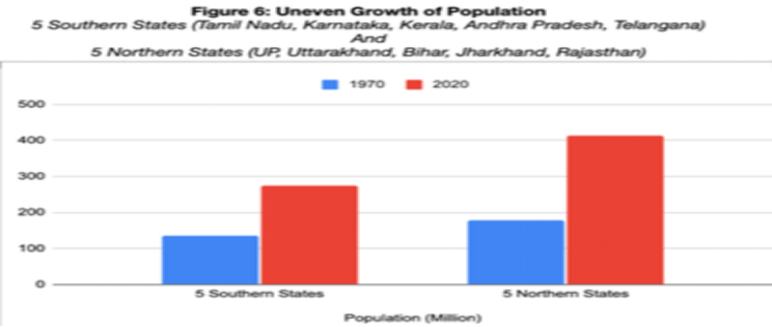
For the period 1970-2020, the population of five northern states viz. Uttar Pradesh, Uttarakhand, Bihar, Jharkhand and Rajasthan showed an increase in the population of 178 percent. These states have a combined representation of 164 seats in Parliament as of 2019. Based on the above, in terms of the Constitution, these five states will get seats in proportion to their population increase. Their seat share thus increases by 178 percent to a total of 455 seats.
In the five southern states of Tamil Nadu, Karnataka, Kerala, Andhra Pradesh and Telangana, the states have a combined representation of 129 seats in Parliament as of 2019. The combined population of these five states increased by 102 percent over the period 1970-2020. Based on the population increase of 102 percent, their share of seats in the Lok Sabha would increase by 102 percent to give them a revised seat share of 260 seats. Based on percentage increase of population, the Southern states hence stand to lose significantly in representation in the Lower House while the Northern states, which faulted on population control measures, stand to gain.
Increasing seat share based on the proportional increase in population will hence disempower the South in comparison to the North, simply because they have carried out the required population control measures in a more effective manner than states in the Northern half of the country. This will create grounds for unrest with severe consequences. The solution hence would be to further defer the expansion, or to simply increase the number of seats in parliament in the same proportion as are currently existing. It must also be noted that even amongst the Southern states, population increase is not uniform as states like Kerala and Tamil Nadu have fared far better than Karnataka.
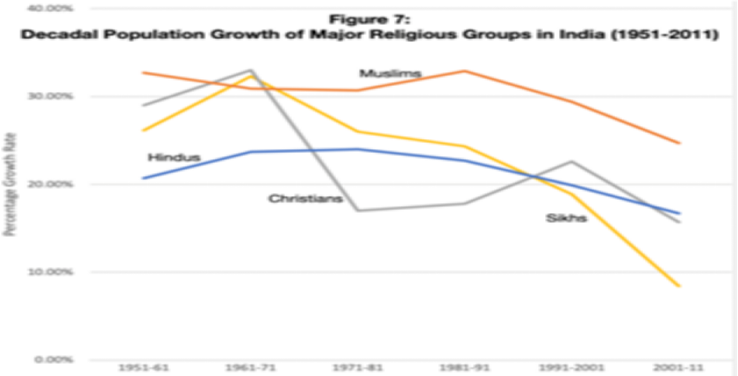
Religious fault lines too are beginning to appear because of uneven growth of different religious groups. Data available till the 2011 census indicates decadal population growth of all religious groups has declined but the rate of decline is different for different religious denominations (Figure 7).[vii] For each of the decades from 1951-2011, the decadal growth of the Muslim population has been about 10 percentage points higher than non-Muslims. In 2011, while the decadal growth rate of non-Muslims is veering towards the 10 percent decadal growth mark, the decadal growth of the Muslim population remains above the 20 percent decadal growth mark. In states like West Bengal, Kerala, Tamil Nadu, UP and Assam, this is manifesting in societal tension which has the potential to lead to communal discord and splitting of communities on communal lines. Here too, as in the North-South divide, those religious groups which have been more effective in population control measures stand to lose out to those that have disregarded the same. Obviously, there is a need to implement strict family planning norms through a series of incentives and disincentives. The aim must be to get all groups to limit decadal population growth to between 0 and 5 percent.
To conclude, India as of now is on a cusp, where the country can break out as a middle-income country by 2047. This process will be greatly facilitated by the implementation of population control measures, uniformly across all strata of society and across the length and breadth of the country. This needs to be a priority call for India’s polity and civil society, to preserve the unity and integrity of the nation, prevent fissiparous tendencies and for the economic welfare of all sections of India’s population.
The implications of the growing population on human development in India
India can reap the benefits of demographic change and achieve equitable and sustainable development for its growing population only through a holistic and integrated approach.
India, having surpassed China as the most populous nation in the world, is facing challenges due to its fast-growing population. With over 1.4 billion people and an estimated annual growth rate of approximately 1 percent, this demographic trend has complex and far-reaching implications on human development in India. India’s population is expanding at an unsustainable rate and is projected to surpass 1.5 billion people by 2030 and 2 billion people by 2050.
Figure 1:
Source: Rebecca Bundhun, The National
The country’s rapid population growth puts pressure on resources and services, leading to environmental degradation, poverty, and inequality. The burden on the healthcare system increases, making access to quality healthcare a challenge. Education infrastructure struggles to meet the needs of a growing population, and urbanisation strains infrastructure and basic services. Environmental concerns arise due to the large population’s impact on natural resources. Additionally, population growth also creates a dearth of employment opportunities.
Only through a holistic and integrated approach can India reap the benefits of demographic change and achieve equitable and sustainable development for its growing population.
Economically, the expanding population necessitates the creation of adequate employment opportunities to accommodate the growing workforce. As per the Center for Monitoring Indian Economy, unemployment in India is at an all-time high of 8.5 percent. Another challenge is poverty<1>, with nearly 16.4 percent population living in poverty and about 4.2 percent living in severe poverty. Figure 2 below indicates the drastic increase in wealth inequality in India in the past four decades, with the top 10 percent possessing more than 60 percent of the total wealth. It also indicates the decline in wealth of the bottom 50 percent of the population.
Figure 2:
Source: Maitreesh Ghatak et al., The India Forum
Addressing poverty and wealth inequality will become increasingly difficult as populations grow, requiring equitable distribution of resources and access to essential services. The strain on infrastructure such as housing and transport will increase, and large investments will be required to meet the needs of the growing population. As the population continues to grow, it becomes increasingly difficult to support the socio-economically disadvantaged groups. Rapid urbanisation leads to urban overcrowding and poor urban planning, creating problems such as slums, traffic congestion, and the lack of access to basic amenities. Governments need to focus on implementing policies that promote inclusive growth, entrepreneurship, and skills development to combat unemployment and ensure sustainable economic development.
Governments need to focus on implementing policies that promote inclusive growth, entrepreneurship, and skills development to combat unemployment and ensure sustainable economic development.
Providing quality education and healthcare is difficult given the limited resources and infrastructure available. Creating social solidarity and harmony amongst different social groups is essential to keep conflict at bay and improve social advancement. Making sure resources and access to quality learning, healthcare, and essential services is critical to reducing poverty and inequality. With 1.2 billion children out of school in 2022-23, the education system needs to be strengthened to ensure universal access to education, skill development, and vocational training. In 2021-22, India’s public expenditure on healthcare was nearly 2.1 percent of GDP, as compared to 1.8 percent in 2020-21 and 1.3 percent in 2019-20, which highlights the growing importance of public healthcare and social security for universal health coverage. A shortage of beds is evident with only 0.5 public hospital beds per 1,000 population available as against WHO standard of 1 bed per 1,000 people. There is an urgent need to enhance healthcare services, including primary healthcare, maternal and child healthcare, and infrastructure for specialised treatments.
From an ecological perspective, population growth puts enormous pressure on natural resources, leading to overconsumption, deforestation, water scarcity, and pollution. According to the Global Carbon Budget Report 2022, India’s coal, oil, and gas emissions are projected to grow by 6 percent. Sustainable management of natural resources and conservation practices are essential to meet these challenges and ensure long-term sustainability. Population growth increases greenhouse gases and accelerates climate change. India needs to implement green policies, promote renewable energy sources, and adopt sustainable practices to mitigate the negative effects of climate change. Promoting a sustainable lifestyle and raising awareness of the importance of environmental protection are important steps that need to be taken toward a greener future.
While the challenges are significant, it is important to recognise that population growth also provides opportunities for innovation, entrepreneurship, and socio-economic progress.
The impacts of India’s growing population on human development are multifaceted, impacting different areas of the economy, society, and the environment. Equitable growth, inclusive policies, resilient infrastructure, improved education and health systems, and sustainable practices are essential for seizing opportunities and meeting the challenges posed by a rapidly growing population. While the challenges are significant, it is important to recognise that population growth also provides opportunities for innovation, entrepreneurship, and socio-economic progress. To effectively address these impacts, governments should work with civil societies and international partners to develop comprehensive and sustainable policies that promote equitable growth, strengthen social infrastructure, and ensure environmental protection to promote human development. Only through a holistic and integrated approach can India reap the benefits of demographic change and achieve equitable and sustainable development for its growing population.
I. Development Divide
One of the most prominent social implications of population growth in India is the widening development divide across regions and communities. Population growth has not been uniform across the country. States such as Uttar Pradesh and Bihar continue to experience higher fertility rates compared to southern states like Kerala and Tamil Nadu, where fertility rates have declined significantly. This uneven demographic transition has contributed to disparities in income levels, literacy rates, healthcare access, and employment opportunities.
Rapid population growth in economically weaker states often exacerbates poverty. Larger family sizes can limit household investments in education and health, perpetuating cycles of deprivation. In contrast, states that have achieved lower fertility rates have been better able to invest in human capital, resulting in higher literacy levels, improved health outcomes, and stronger economic performance.
Urban-rural disparities also highlight the development divide. Cities such as Mumbai and Delhi attract migrants seeking employment, leading to urban overcrowding, informal settlements, and strained public services. Meanwhile, rural areas often struggle with underemployment and limited infrastructure. Population pressure in rural regions can lead to fragmentation of agricultural landholdings, reducing productivity and increasing rural distress.
Gender disparities are another dimension of the development divide. Although improvements have been made, population growth has often intensified pressures on women’s access to education, employment, and healthcare. In some regions, early marriage and limited reproductive health services contribute to higher fertility rates, reinforcing social inequalities.
II. Opportunities and Challenges
India’s large population presents a dual reality of opportunities and challenges. On the opportunity side, India has one of the youngest populations in the world, with a median age significantly lower than many developed countries. This demographic structure offers the potential for a substantial demographic dividend—an economic boost resulting from a higher proportion of working-age individuals relative to dependents.
A youthful workforce can drive economic growth through increased labor supply, innovation, and entrepreneurship. India’s expanding digital economy, service sector, and startup ecosystem demonstrate the potential of its young population. Sectors such as information technology, renewable energy, and manufacturing can benefit from a large pool of skilled labor.
However, the realization of this demographic dividend is not automatic. It requires substantial investments in education, vocational training, healthcare, and job creation. Without sufficient employment opportunities, a large youth population can lead to unemployment, social unrest, and economic stagnation. The challenge lies in generating enough quality jobs to absorb millions entering the labor market each year.
Environmental sustainability is another critical challenge. Population growth increases demand for land, water, energy, and food. Rapid urbanization has led to pollution, deforestation, and depletion of natural resources. Climate change further compounds these pressures, making sustainable development an urgent priority.
Healthcare and education systems also face strain due to population growth. Expanding access while maintaining quality is a persistent challenge. Public expenditure must keep pace with demographic demands to ensure inclusive development.
III. Strategies for Balanced Development
Balanced population growth requires comprehensive and inclusive strategies. First, strengthening family planning and reproductive health services is essential. Access to contraception, awareness campaigns, and women’s empowerment programs can help stabilize fertility rates. States that have successfully reduced fertility rates often emphasize female education and healthcare.
Second, investing in human capital is critical. Quality education, particularly for girls, has a transformative impact on fertility rates and economic participation. Skill development programs aligned with market needs can enhance employability and productivity.
Third, promoting regional development can reduce migration pressures and regional disparities. Infrastructure investments, industrial corridors, and rural development schemes can create local employment opportunities. By fostering balanced economic growth across states, India can mitigate the development divide.
Fourth, sustainable urban planning is vital. Smart city initiatives, improved public transportation, and affordable housing can help manage urban population growth more effectively. Environmental protection measures must be integrated into development planning to ensure long-term sustainability.
IV. Policy Frameworks and Historical Context
India’s approach to population policy has evolved over time. In 1952, India became one of the first countries in the world to launch a national family planning program. Early efforts focused on controlling population growth through awareness campaigns and access to contraception. During the 1970s, controversial coercive sterilization campaigns during the Emergency period led to public backlash and shaped future policy approaches.
Over the decades, population policy shifted from target-driven approaches to a more holistic focus on reproductive health and rights. The National Population Policy of 2000 emphasized voluntary and informed choice, maternal health, and child survival. It set goals for reducing infant mortality, maternal mortality, and fertility rates.
Economic reforms initiated in 1991 also influenced demographic dynamics. Liberalization accelerated urbanization, migration, and shifts in employment patterns. Integration into the global economy created new opportunities but also intensified regional inequalities.
Government programs such as rural employment guarantees, public health missions, and educational reforms aim to address the social and economic consequences of population growth. However, effective implementation remains crucial to achieving desired outcomes.
V. Case Studies in Integrated Development
Kerala provides a compelling case study of integrated development. Despite relatively modest economic resources, the state achieved significant improvements in literacy, healthcare, and gender equality. High female literacy and access to healthcare contributed to a decline in fertility rates and improved human development indicators. Kerala’s experience demonstrates that social investments can shape demographic outcomes.
Tamil Nadu is another example of successful population stabilization combined with industrial growth. Proactive public health measures and social welfare schemes have contributed to demographic transition and economic progress.
In contrast, states with persistently high fertility rates often struggle with lower educational attainment and limited healthcare infrastructure. Addressing these disparities requires context-specific strategies that combine economic development with social reforms.
Urban case studies also reveal lessons in integrated planning. Initiatives aimed at slum redevelopment, public transport expansion, and digital governance illustrate how cities can adapt to population pressures while improving living standards.
VI. Recommendations for Policy Prioritization
- To effectively manage the social and economic implications of population growth, policymakers should prioritize several key areas:
- Enhancing Female Education and Empowerment: Education for girls is one of the most effective tools for reducing fertility rates and improving economic participation. Policies should ensure access to secondary and higher education.
- Expanding Skill Development Programs: Aligning training programs with emerging sectors such as technology and green energy can maximize the demographic dividend.
- Strengthening Healthcare Systems: Universal access to quality healthcare, particularly reproductive and maternal services, is essential for population stabilization.
- Promoting Sustainable Development: Integrating environmental considerations into economic planning can mitigate resource depletion and climate risks.
- Reducing Regional Inequalities: Targeted investments in lagging states can bridge development gaps and foster inclusive growth.
- Encouraging Data-Driven Governance: Accurate demographic data and evidence-based policymaking can improve program effectiveness.
Conclusion
India has the most number of poor people in the world, one of the highest proportion of wasted and stunted children, alarming levels of unemployment, especially among the youth, and one of the lowest levels of participation in the workforce by women. Unless India finds policy solutions to address these gaps, having a higher proportion of population in the working-age group will, far from helping matters, likely cause social unrest.
India’s population growth is both a challenge and an opportunity. As the world’s most populous nation, surpassing China, India stands at a critical juncture. Its youthful demographic profile offers the potential for sustained economic growth and global influence. However, without adequate investments in human capital, job creation, and sustainable development, population pressures could exacerbate social inequalities and environmental degradation.
The social and economic implications of population growth are deeply interconnected. Addressing them requires coordinated policies that prioritize education, healthcare, gender equality, and regional balance. Lessons from states like Kerala and Tamil Nadu demonstrate that integrated development strategies can yield transformative results.
Ultimately, population growth should not be viewed solely as a problem to be controlled but as a dynamic force to be harnessed. By aligning demographic trends with inclusive and sustainable policies, India can transform its population into its greatest asset, ensuring prosperity and equity for future generations.