
Introduction
Urbanization can have a dramatic impact on resources and ecosystems. Despite this impact, there has been little attention devoted explicitly to the effect of urbanization. The purpose of this paper is to consider these potential impacts and to suggest policies that would mitigate potential negative impacts. Four basic issues are considered here. First, we present an assessment of the extent of the urbanization process. This discussion suggests that the problem is looming larger but has been largely ignored in discussions of the environment. Second, we provide details on potential consequences of urbanization on the stock and productivity of natural resources, both within and outside the urban area. Third, we consider the magnitude and nature of externalities associated with urbanization. Appropriate policies are then presented. Urbanization can clearly have significant environmental effects. By its nature, urbanization implies considerable effects on both stock and flow of natural resources. There is significant loss of land, which by itself is an important natural resource. It should be kept in mind that a large portion of the urban population lives in a small number of densely populated urban centers and in a small fraction of the global land area, which are often characterized by severe resource allocation problems. Other natural resources such as water, energy, minerals, etc. are also used at disproportionately high rates. On the flow side, urban areas are significant stands and sinks for air and water pollution, and noise. In many cases, natural site characteristics or investments in urban construction determine the extent and impact of environmental degradation. The problem is that the prices that agents face do not reflect these costs. As a result, urbanization creates negative impacts on the stock and flow patterns of natural resources. In this sense, urbanization is an environmental problem.
Urbanization is one of the most transformative processes shaping the modern world. It refers to the increasing concentration of populations in urban areas, accompanied by the physical expansion of cities and towns. Over the past two centuries, especially after the Industrial Revolution, urbanization has accelerated rapidly, driven by economic growth, industrialization, technological advancement, and demographic shifts. Today, more than half of the world’s population lives in urban areas, and this figure is projected to rise to nearly 70 percent by 2050.
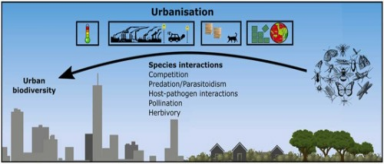
While urbanization has played a critical role in economic development, poverty reduction, and improved access to services, it has also exerted immense pressure on natural ecosystems. Forests, wetlands, rivers, coastal zones, and agricultural lands are increasingly being converted into built environments. The resulting loss of biodiversity, environmental degradation, and disruption of ecological processes pose serious challenges to sustainable development.
Understanding Urbanization and its Drivers
Urbanization occurs as the population within a defined area increases and population growth is accompanied by the destruction of natural habitat and its replacement by human settlements, infrastructure, and industry. Nations, as well as the global population as measured by the United Nations, often use the percentage of the population that resides in urban areas as a proxy measure for the level of urbanization. While the use of this single measure is a convenient way to compare the degree of urbanization within or across nations, urbanization is actually a process that consists of three dynamic elements – population, settlement, and land use – occurring at different times and with patterns that are unique for each region or nation. High urbanization rates do not necessarily signal a robust economic growth. Global experiences over the past few decades have shown that a common pathway towards enhanced productivity, higher living standards, and economic development is the growth of cities and urbanization. Insufficient urbanization, however, leads to inefficient levels of urban concentration, resulting in increased congestion and lower incomes for all. Several key factors are considered most influential in promoting urbanization. Structural change in an economy triggers the movement of workers from agricultural to non-agricultural occupations, either directly or through a process of shifting from villages into urban areas. Continued urbanization stimulates the process of structural change via a range of mechanisms. Next, cities or urban areas serve as economic engines and attract workers and firms that prefer larger markets. Urban agglomeration externalities develop in urban areas, relating to information, input-output linkages, spillovers, and knowledge, which benefit firms in an existing market or new entrants. Large cities offer better employment prospects and wage levels. Third, public policies that channel resources to favor the development of places and sectors of a territory tend to lead to higher employment in these areas. The existence of larger and more dynamic urban centers in different regions is, therefore, supported by policies aimed at improving economic conditions in selected cities, as well as industrial strategies to attract knowledge-based industries.
Effects of Urbanization on Natural Resources
Effects of urbanization on natural resources and the environment In the past, urban populations grew primarily through migration from rural areas and from increases in birth rates. The recent rapid urban growth in developing countries, however, appears to be largely a result of natural increase. The resulting cities are often ill-equipped to deal with huge numbers of new residents. Urban areas demand vast areas of new residential, commercial, and industrial developments, as well as providing public facilities such as roads, transportation facilities, water supply, communications, and waste disposal. This intense demand for space leads to an increase in land prices, and farmland often converts to residential areas rather than to other urban uses. Unsustainable land uses such as deforestation, landfills, and over-quarrying of rock are on the large. Rapid natural land cover change leads to the reduction of sensitive habitats, loss of biodiversity, and reduction of wildlife and bird populations. Rapid land conversions contribute to the permanent destruction of agricultural lands and production capacity for future agricultural use.
3.1. Water Resources
Water is essential for everything that lives. The relation between hydrological regimes, ecology, water quality, and the water demand-induced pressure must be carefully regulated to guarantee a sustainable water system. Urbanization directly alters the flow, sediment, and pollutant characteristics of rivers and indirectly influences water quality and groundwater quantity through landscape modifications. In the process of urbanization, materials with high thermal conductivity, like stone, brick, and concrete, replace farmland soil, which has an impact on the local climate. Urban sprawl can lead to warmer summer conditions and reduced wintertime minimum temperatures in urban areas. Runoff levels increase with urbanization and in some cases only 50-20% of rainfall is retained. Consumers’ increasing demand for water due to population growth and an imbalance in the pattern of urban construction have disrupted the eco-hydrological equilibrium of the rivers which supply water for the city of Taiyuan. Therefore, the local authority is required to undertake a series of countermeasures to protect its water supply.
The land area of the United States is about 2.3 billion acres, of which 1.9 billion acres are privately owned and 95 percent of them are used for agriculture, forestry, and other commercial purposes. There seems to be more land on which to develop, but most future growth will take place in the cities where it is most desired. Land-use conversion is at its most damaging when it occurs on lands of high environmental or productive value. Urbanization not only removes the resource benefits of plant cover and soil but also poses challenges in such areas as storm recognition and runoff problems, which agriculture has minimal effects on and which controls are largely outside our force of experience. Most of the nation’s arable farmlands have already been exploited. Moreover, the loss of Class I, II, and III arable soils to all development has caused a serious decline in the quality of resulting most fertile farmlands.
3.3. Air Quality
The growing number of inhabitants and economic growth in urban areas are generally accompanied by increasing quantities of production and consumption of goods and services, more motorized and non-motorized transport, heating, industrial and industrial-related activities, power generation, increased waste production and unregulated expansion. These factors create the so-called slums, informal settlements or squatter settlements. Pervious soil surfaces are gradually being replaced by impervious materials such as concrete, asphalt or roofing materials that cannot support vegetation. This makes space and increases vulnerability of built-up areas to extreme events and greater capacity to receive atmospheric moisture. These aspects often result in a series of environmental and health problems that make many urban areas unhealthy, uncomfortable and potentially dangerous. Urban areas today face various problems that are global in nature and result in varying degrees of air pollution. This pollution not only has localized negative effects but also affects urban opportunities, biodiversity, water quality, terrestrial and aquatic ecosystems, both of anthropogenic origin and climate change.
4. Effects of Urbanization on Ecosystems
Human activities often alter natural landscapes by changing the diversity, structure, processes, and dynamics of ecosystems. One of the most widespread and significant forms of human influence on the environment is urbanization, which converts natural lands into urban infrastructure supporting densely settled populations. Urban land uses include residential, commercial, and industrial structures, built infrastructure like roads and utilities, as well as less dense and more diffuse uses like schools, parks, cemeteries, and golf courses. Increasingly, areas that are dominated by rural land uses also exhibit urban characteristics like relatively intense human uses and large areas of paved surfaces. These rural/urban interface areas are considered “ex-urban” because they are neither rural nor urban or as front country because they form transitions between more pristine natural environments and more intensely developed urban environments.
I. Development Divide
Urbanization often creates a pronounced development divide—both between urban and rural areas and within cities themselves. On one hand, urban centers tend to attract investment, infrastructure, education, and healthcare, becoming hubs of economic opportunity. On the other hand, rural and peri-urban regions frequently experience neglect, leading to uneven development patterns.
This divide has significant ecological implications. As cities expand, they encroach upon surrounding natural ecosystems, often located in rural or semi-rural areas. Forests are cleared for housing and industry, wetlands are drained for real estate development, and rivers are altered to meet urban water demands. These changes disproportionately affect communities dependent on natural resources for their livelihoods, deepening social and environmental inequalities.
Within cities, the divide is equally stark. Affluent neighborhoods may enjoy green spaces, cleaner environments, and better services, while informal settlements and slums often develop in ecologically fragile zones such as floodplains, hillsides, and coastal areas. These populations are more vulnerable to environmental hazards, including floods, heatwaves, and pollution, illustrating how urbanization can amplify both social and ecological vulnerability.
II. Opportunities and Challenges
Urbanization presents both opportunities and challenges for natural ecosystems. On the opportunity side, cities can promote efficiency through compact living, shared infrastructure, and technological innovation. Well-planned urban areas can reduce per capita land use, energy consumption, and greenhouse gas emissions compared to dispersed rural settlements. Urban centers also provide platforms for environmental innovation, including green buildings, renewable energy systems, and sustainable transportation networks.
Furthermore, urbanization can reduce pressure on certain ecosystems if rural populations shift away from environmentally harmful practices such as deforestation for subsistence agriculture. Cities can also serve as centers for environmental awareness, research, and governance.
However, the challenges are substantial. Rapid and unplanned urban growth often leads to habitat destruction, air and water pollution, waste accumulation, and the fragmentation of ecosystems. Urban heat islands alter local climates, while impervious surfaces increase runoff and flooding. The demand for resources—water, energy, food, and construction materials—extends the ecological footprint of cities far beyond their boundaries, affecting distant ecosystems through resource extraction and waste disposal.
Balancing these opportunities and challenges requires deliberate planning, strong institutions, and a long-term ecological perspective.
III. Strategies for Balanced Development
Achieving a balance between urban growth and ecosystem preservation requires integrated strategies that recognize the interdependence of human and natural systems. One key approach is sustainable urban planning, which emphasizes compact city design, mixed land use, and efficient public transportation to limit urban sprawl.
The integration of green infrastructure is another vital strategy. Urban forests, parks, green roofs, wetlands, and river buffers can enhance biodiversity, regulate temperature, manage stormwater, and improve air quality. These nature-based solutions not only protect ecosystems but also enhance human well-being.
Ecosystem-based urban management encourages cities to work with natural processes rather than against them. Protecting watersheds, restoring degraded habitats, and maintaining ecological corridors within and around cities help sustain ecosystem services such as water purification, pollination, and climate regulation.
Public participation and community-based planning are also essential. When local communities are involved in decision-making, urban development is more likely to reflect social and ecological priorities, leading to more equitable and sustainable outcomes.
IV. Policy Frameworks and Historical Context
The relationship between urbanization and ecosystems has evolved over time. During the early phases of industrialization, urban growth was largely unregulated, resulting in severe environmental degradation. Rivers became polluted, green spaces disappeared, and public health crises emerged. These experiences gradually led to the development of environmental regulations and urban planning policies in many countries.
In recent decades, global policy frameworks have increasingly recognized the need for sustainable urbanization. Concepts such as sustainable development, smart growth, and resilient cities have gained prominence. International agreements and agendas emphasize the integration of environmental considerations into urban planning and governance.
National and local governments play a crucial role in translating these frameworks into action. Land-use regulations, environmental impact assessments, zoning laws, and conservation policies are essential tools for managing urban expansion and protecting ecosystems. However, policy implementation often faces challenges such as weak enforcement, institutional fragmentation, and competing economic interests.
V. Case Studies in Integrated Development
Several cities around the world provide valuable lessons in integrating urban development with ecosystem protection. For example, some cities have successfully restored urban rivers by removing concrete channels, improving water quality, and creating recreational green spaces. These initiatives have enhanced biodiversity while revitalizing urban areas economically and socially.
Other examples include cities that have adopted transit-oriented development to reduce car dependence and limit urban sprawl. By concentrating growth around public transportation hubs, these cities have preserved surrounding natural landscapes and reduced emissions.
In rapidly urbanizing regions, innovative approaches such as eco-cities and green belts have been implemented to manage growth. While not without challenges, these experiments demonstrate that urbanization does not inevitably lead to ecological destruction if guided by sound planning and governance.
VI. Recommendations for Policy Prioritization
To minimize the negative impacts of urbanization on natural ecosystems, several policy priorities should be emphasized:
- Strengthen land-use planning to prevent unchecked urban sprawl and protect ecologically sensitive areas.
- Promote nature-based solutions as cost-effective and sustainable alternatives to conventional infrastructure.
- Enhance institutional coordination among urban, environmental, and regional planning authorities.
- Invest in data and monitoring systems to assess ecosystem health and guide evidence-based decision-making.
- Ensure social equity by providing all urban residents with access to green spaces and a healthy environment.
- Encourage public participation and awareness, fostering a sense of shared responsibility for urban ecosystems.
By aligning economic development goals with ecological sustainability, policymakers can guide urbanization toward more resilient and inclusive outcomes.
Conclusion
The growth of the world’s population facilitates the demand for basic needs, such as food, water, and other resources, leading to changes in land-use patterns which exacerbate the human footprint on the environment. Additionally, these changes in land and water management intensify the rate and magnitude of natural disasters, such as floods and landslides. Urbanization intensifies ecosystem modification, like deforestation, soil sealing, land consumption, and overexploitation of water resources. Urban expansion leads to a decline in the number of species and habitat quality, and it is supposed to reduce the ecosystem services. However, this knowledge is still scarce, and more scientific studies are required to improve our comprehension of how land-cover occupation impacts the environment and what the potential solutions are that would aid in the minimization of possible effects. In this context, monitoring land cover and ecosystem modification using Earth Observation (EO) images and GIS becomes an eligible tool to help planners, decision-makers, and stakeholders in designing policies, strategies, and developing management measures and site-specific conservation plans in order to contain or prevent further losses and impacts on biodiversity and ecosystem services. The present review critically analyzed the advances in the studies in the application of EO and GIS regarding urbanization and land conversion. We discuss to what extent the researches are exploring advancements in the characterization and quantification of natural resources and ecosystem services as a function of urban expansion. Therefore, we strongly suggest that a change of paradigm is needed. Only through the enhancement and incorporation of new knowledge into planning decisions, guidelines, and environmental policy will it be possible to reach sustainable management, use, and conservation of ecosystems in a more resilient urban environment. Now the challenges are incorporating new datasets and methodologies in an interdisciplinary approach in the planning field of study that considers a comprehensive evaluation of ecosystem services, integrating economic and social criteria, allowing decisions that properly manage and control urban expansion and its impacts on the ecosystems.
Urbanization is an irreversible and defining feature of the contemporary world. Its impact on natural ecosystems is profound, complex, and multifaceted. While unplanned and poorly managed urban growth has led to significant environmental degradation, urbanization also offers opportunities for innovation, efficiency, and sustainable living.
The challenge lies in bridging the development divide, managing opportunities and challenges effectively, and implementing strategies that harmonize urban growth with ecological preservation. Historical experiences, policy frameworks, and real-world case studies demonstrate that integrated and balanced development is achievable.
Ultimately, the future of urbanization will depend on collective choices made by governments, communities, and individuals. By prioritizing sustainable planning, strong governance, and respect for natural ecosystems, cities can become not only engines of economic growth but also stewards of environmental sustainability.