
Introduction
The retail landscape is experiencing one of the most profound transformations in its history—driven not by traditional competition, but by immersive technology. Augmented Reality (AR) and Virtual Reality (VR) have transitioned from niche entertainment and industrial tools to mainstream agents of change in how people shop, interact with brands, and make purchase decisions. Retail—long defined by its physical stores and in-person experiences—now traverses both digital and physical environments, blurring lines once thought distinct. AR and VR are not just technological novelties; they are revolutionizing retail strategies, customer expectations, and operational frameworks. This transformation reflects broader shifts in consumer behaviors, technological adoption, and corporate innovation strategies. As digital and real-world experiences converge, the integration of AR/VR is unlocking new ways for brands to deliver personalized, interactive, and contextually relevant experiences that reshape the very concept of retail engagement.
To fully appreciate how AR/VR is redefining retail, it is important to understand the historical context that shaped this evolution, the uneven terrain of technology adoption, the opportunities and challenges that arise, and the policy frameworks and strategic approaches needed for balanced integration.
How AR/VR in Retail is Transforming Shopping Experiences
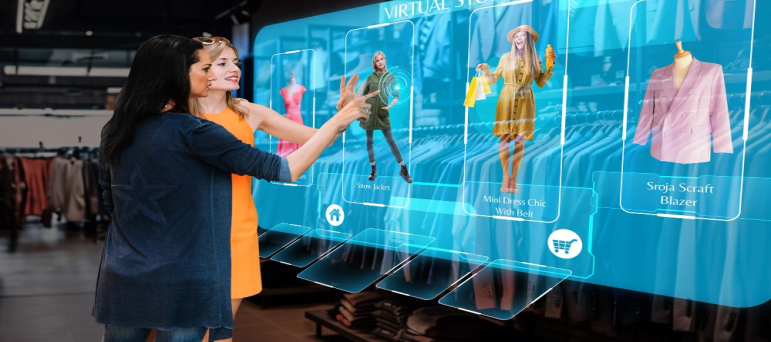
AR/VR in Retail is changing how customers discover, try, and buy products. Instead of static product photos, shoppers now interact with items using immersive retail tech like AR shopping apps, virtual try-on solutions, and fully immersive VR retail experiences. These technologies help customers make confident purchase decisions, reduce return rates, and spend more time engaging with brands. Looking ahead to 2026, experiential retail innovation will focus on spatial computing, WebAR, and AI-driven personalization, making shopping more interactive, visual, and customer-centric than ever before.Retail today is no longer just about shelves, screens, or checkout counters. It is about experience.
AR/VR in Retail has become the bridge between physical and digital shopping. Customers want to see how a product fits, how it looks in their space, or how it feels before buying, especially online. Augmented Reality (AR) and Virtual Reality (VR) make that possible.
From virtual try-on solutions for beauty and fashion to VR retail experiences that recreate entire stores digitally, immersive technology is helping brands reduce uncertainty and build stronger customer confidence. Retailers that adopt these tools are not just upgrading technology; they are reshaping how customers connect with products.
The Strategic Shift: From Transaction to Interaction
The classic retail method was a transaction one: a customer spotted a product and made the purchase. Augmented and Virtual Reality in Retail changes this to an engaging model: a customer saw a product, used it, altered it to his/her taste, and then made the purchase. Customers are given the opportunity to experience the product in their environment through immersive retail technology before deciding to buy it, thus the interaction model is substituting the transaction model.
Reducing Returns with Visualization
Returns are one of the biggest challenges in eCommerce, often reaching 30% or more. Virtual try-on solutions directly address this issue.
By allowing customers to:
Try makeup tones on their face
See the furniture inside their home
Check how glasses or shoes fit
Retailers remove guesswork from the buying process. Studies consistently show that AR-powered visualization can reduce returns by up to 40%, improving profitability and sustainability.
Enhancing Engagement Time
The duration of a user’s visit to a website is the key measure of a site’s value in an attention economy. Many retailers have adopted augmented reality (AR) shopping apps as one of their most powerful weapons to win customer loyalty by providing a playful shopping experience. The time spent by the shoppers on the websites goes up as a result of the implemented strategies. Gamified hunting in a retail space or 3D models that can be manipulated in a product page are some of the methods that are used to tempt customers and make sales more likely.
Partnering with a specialized AR/VR development company is often the first step for brands looking to build these custom, high-fidelity experiences that align with their brand identity.
AR in Action: The “Try-Before-You-Buy” Revolution
Augmented Reality (AR) is a technology that superimposes digital data on the real world, thus making it a very effective tool for “try-before-you-buy” situations.
Virtual Try-On Solutions: The leading cosmetic companies like Sephora and L’Oréal have developed AR mirrors that allow customers to try out as many as hundreds of different shades of makeup in a matter of seconds without the fear of hygienic issues.
Spatial Visualization: The leading furniture manufacturer IKEA makes it possible for users to position life-like 3D models of their expected furniture inside the house just by using the camera of their smartphone.
Interactive Packaging: The AR/VR in retail is used increasingly in order to enhance product packaging. When a wine label is scanned, it may tell the story of the vineyard, thus providing a more engaging experience compared to the static text.
VR Retail Experiences: Immersion Beyond the Screen
While AR enhances the real world, VR retail experiences transport the user to a completely new one. This aspect of the technology allows for total immersion.
Virtual Showrooms: Beauty and fashion brands use AR mirrors to let users try hundreds of looks without touching a product. This builds confidence and shortens decision cycles.
Training and Simulation: Walmart uses VR to train employees on how to handle Black Friday crowds or manage produce sections, ensuring operational excellence without disrupting the shop floor, a key internal benefit of AR/VR in Retail.
Virtual Fashion Shows: Scanning product packaging can unlock videos, tutorials, or brand stories, adding context and emotional value to purchases.
To implement these complex environments effectively, retailers often rely on robust ecommerce development services to integrate VR platforms seamlessly with inventory and checkout systems.
Experiential Retail Innovation: The 2026 Outlook
As we look toward 2026, experiential retail innovation within the immersive tech sector is set to become even more sophisticated.
Spatial Computing: With devices like the Apple Vision Pro, shopping will become a spatial activity. Users will “pull” products out of a screen and inspect them in 3D space.
WebAR: The friction of downloading an app is disappearing. WebAR allows AR shopping apps to run directly in a mobile browser, making immersive commerce accessible to anyone with a link.
AI-Driven Personalization: AI will generate custom AR experiences on the fly. Imagine a virtual mannequin that doesn’t just look like you, but suggests outfits based on your calendar and local weather.
Transform Your Store into an Immersive Destination
Don’t let your retail experience stagnate. Our experts utilize cutting-edge AR/VR in Retail technologies to build shopping journeys that captivate customers and drive measurable growth.
Build Your Immersive Strategy!
Case Studies: Immersive Success Stories
Case Study 1: Luxury Watch Retailer
The Challenge: High-end watches are difficult to sell online because customers want to gauge the fit and finish on their wrist.
Our Solution: We developed a markerless AR/VR in Retail experience. Users could point their camera at their wrist to see a hyper-realistic, light-reactive 3D model of the watch.
The Result: The conversion rate for users who engaged with the feature increased by 40%, and the brand saw a significant reduction in “bracketing” (buying multiple sizes to return ones that don’t fit).
Case Study 2: Big Box Retail Navigation
The Challenge: Customers were frustrated by the inability to find products in massive warehouse-style stores.
Our Solution: We implemented an in-store AR/VR in retail experience powered by augmented reality technology. Users typed in a product, and an AR arrow on their phone screen guided them through the aisles directly to the item.
The Result: Customer satisfaction scores rose by 15%, and the app collected valuable data on foot traffic patterns for store optimization.
Tech Stack for Immersive Retail
We leverage industry-leading tools to build these experiences.
AR Platforms: ARKit (Apple), ARCore (Google), 8th Wall (WebAR).
3D Engines: Unity, Unreal Engine.
Modeling: Blender, Maya, Adobe Substance 3D.
Hardware: Meta Quest 3, Apple Vision Pro, Mobile Devices (LiDAR enabled).
AR and VR in Retail: Game-Changing Use Cases & Benefits
Retail is evolving fast, and customer expectations are evolving with it.
Where once a product photo and description were enough, shoppers now expect to interact with products before they buy even online.
That’s where Augmented Reality and Virtual Reality step in. These immersive technologies are transforming how retailers present products, train staff, and create memorable experiences. From a customer trying on a pair of sunglasses through their phone to a store associate learning new skills in a VR simulation, the possibilities are expanding every year.
This guide explores how AR and VR are being applied in retail today, the benefits and challenges, and what’s coming next.
AR vs VR in Retail Key Differences and How They Work
Both AR and VR change the way we see and experience products but they do it differently:
Augmented Reality adds a digital layer to the real world. Through a smartphone camera, tablet, or AR glasses, shoppers can preview furniture in their living room, try on lipstick, or see product details overlaid on a store shelf.
Virtual Reality creates an entirely digital environment. Using a VR headset, a shopper can walk through a virtual showroom, explore products from all angles, or experience a simulated brand event.
To understand the core principles, benefits, and real-world examples of augmented reality in retail, read our detailed guide on the future of retail with AR technology.
Five High-Impact AR/VR Retail Applications
1. Virtual Try-Ons
AR-powered try-on tools let shoppers instantly see how products will look on them — no fitting room required.
Fashion: AR mirrors in-store allow outfit changes in seconds.
Beauty: Apps from brands like Sephora and L’Oréal let customers test multiple makeup shades virtually.
Eyewear: Warby Parker’s AR try-on app matches glasses to your face shape with precision.
The result? Less uncertainty, more confidence, and fewer returns.
2. Virtual Showrooms and Store Tours
With VR, retailers can create fully immersive store experiences customers can access from home.
Luxury brands are using VR showrooms to replicate the feel of an exclusive in-store visit, complete with curated product displays. It’s an opportunity to reach customers in new markets and showcase high-value products in a premium setting.
3. Interactive Product Visualization
For big purchases like furniture or appliances, seeing is believing.
AR apps let shoppers place life-size 3D models into their own space to check dimensions, style, and color. IKEA and Wayfair have set the benchmark for this, turning “maybe” into “yes” by letting customers preview products in context.
Brands like IKEA and Wayfair lead the way in AR shopping experiences, helping reduce returns and boost sales Shopify reports a 250% increase in conversions with AR.
4. AR Navigation and In-Store Assistance
Finding your way around a large store can be frustrating. AR wayfinding tools overlay arrows and directions onto your phone’s camera view, guiding shoppers to the right aisle or product. Retailers can also integrate special offers or related product suggestions into these navigation paths — enhancing both convenience and sales potential.
5. VR Training for Retail Staff
Immersive training simulations allow staff to practise customer service, product demonstrations, or even safety procedures without disrupting operations.
Companies like Walmart have used VR to train employees for Black Friday rushes, giving them hands-on experience in managing high-pressure scenarios.
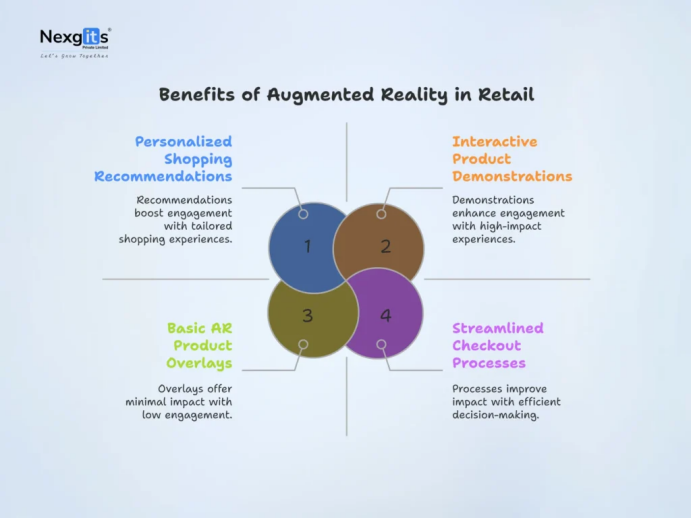
Key Benefits of AR and VR in Retail For Shoppers and Retailers
For customers, AR and VR deliver:
Confidence in purchases: Products are previewed in real-world context.
Convenience: Less time spent in fitting rooms or returning items.
Engagement: Shopping becomes interactive and memorable.
For retailers, the benefits include:
Reduced return rates: Visualization narrows the gap between expectation and reality.
Increased conversion rates: Shoppers buy faster when they’re sure.
Deeper insights: Tracking AR/VR interactions reveals customer preferences and behaviors.
Challenges of Implementing AR and VR in Retail And How to Overcome Them
While AR and VR adoption in retail is accelerating, several hurdles still stand in the way:
Upfront Development Costs: Creating high-quality 3D models, interactive AR filters, or immersive VR environments requires a significant investment in both time and money.
Device Limitations: Not every shopper owns an AR-capable smartphone or a VR headset, limiting the reach of immersive campaigns.
Integration Complexity: For AR/VR tools to be truly effective, they must seamlessly connect with existing retail systems, such as inventory management, e-commerce platforms, and analytics tools.
How Retailers Can Tackle These Challenges:
Many start small for example, launching AR try-ons for a single product category or creating a basic VR store tour. By measuring early ROI, retailers can make a data-driven case for scaling up their immersive offerings.
A recent study shows AR/VR technology can reduce product returns by 30% and boost conversion rates by over 20%, helping justify the initial investment and accelerating adoption.
The Road Ahead Future AR and VR Trends in Retail
Retail technology is evolving fast, and AR/VR will play a central role in shaping the next decade of shopping. Key trends to watch include:
AI-Powered Personalization: Augmented reality experiences will adapt in real time based on a customer’s browsing history, purchase patterns, and preferences, creating a unique shopping journey for every individual.
Mixed Reality Shopping: Devices like Apple Vision Pro are enabling mixed reality shopping, merging digital displays with the physical retail world. This allows shoppers to interact with products in a hybrid environment before making a purchase.
Smarter In-Store Guidance: AR navigation tools, integrated with loyalty programs, will direct customers to products based on their shopping list, promotions, and personal preferences.
These innovations promise a retail experience that is more efficient, highly personalized, and deeply engaging for shoppers while also boosting profitability for retailers.
Bringing AR and VR Into Your Retail Strategy
AR and VR are no longer optional “nice-to-have” features they’re becoming a competitive necessity. Retailers that invest in immersive technologies now will be better positioned to meet evolving customer expectations, reduce friction in the buying journey, and outpace competitors.
If you’re ready to explore practical, ROI-focused ways to integrate AR and VR into your business, our custom AR/VR development services can help you design, build, and deploy solutions tailored to your needs.
I. Development Divide
Technological Roots
AR and VR emerged from distinct roots: Virtual Reality aims to immerse users in fully digital environments, while Augmented Reality overlays digital information onto the physical world. Both technologies matured through advances in computing power, graphics rendering, motion tracking, and sensor technologies. Early VR systems were bulky and expensive, often used in pilot training, architecture, or scientific simulations. AR, until recently, was limited by mobile processing power and inadequate displays.
Today, lightweight VR headsets, smartphone-based AR applications, and wearable devices are democratizing access. Apple, Google, Meta, and Microsoft are investing heavily in AR/VR platforms, signaling confidence in widespread adoption. This greater accessibility accelerates innovation in retail contexts—from virtual dressing rooms to AR navigation in stores.
Adoption Disparities
Despite rapid technological progress, the development divide remains an issue. Large, well-capitalized retailers are better positioned to experiment with AR/VR pilots and integrations. Luxury brands and global chains can deploy virtual showrooms and high-end immersive experiences, while small and medium enterprises (SMEs) may struggle with costs, expertise gaps, and integration complexities.
Additionally, geographic disparities persist. Wealthier urban markets with robust digital infrastructure have higher adoption rates of advanced retail technologies compared to regions with limited broadband and digital ecosystems. This divide creates uneven experiences for consumers and varying competitive pressures for retailers, potentially reinforcing economic and technological inequalities.
II. Opportunities and Challenges
AR/VR presents a spectrum of opportunities for retail innovation, but also significant challenges that must be addressed for sustainable integration.
Opportunities
1. Enhanced Customer Engagement and Experience
AR/VR can transform passive browsing into interactive experiences. Instead of static product listings, customers can virtually try on clothes, visualize furniture in their homes, or experience 3D product demos. These immersive interactions deepen engagement, encourage longer browsing, and reduce uncertainty—especially for products where fit and context matter.
2. Personalization and Data-Driven Insights
By tracking user interactions in virtual environments, retailers can gather behavioral insights that inform personalization. AR/VR platforms can adapt recommendations based on user preferences, visual choices, and navigation patterns, making shopping more intuitive and tailored.
3. Bridging Online and Offline Experiences
AR/VR acts as a bridge between digital and physical retail. Virtual showrooms can expand product access beyond store footprints, while AR can guide customers through brick-and-mortar locations with on-shelf information, product comparisons, and interactive promotions—enhancing in-store convenience and discovery.
4. New Revenue Streams and Business Models
Retailers can monetize virtual spaces, offer premium virtual services (e.g., bespoke virtual consultations), or license AR experiences. VR events like virtual fashion shows or exclusive product launches can become revenue generators and brand differentiators.
Challenges
1. Cost and Accessibility
The technological infrastructure for comprehensive AR/VR retail experiences can be costly. High-quality VR headsets, 3D content creation, and integration with backend systems require significant investment. This cost can be prohibitive for smaller retailers without specialized IT teams or financial resources.
2. Technical Limitations and User Experience Issues
Not all consumers have access to AR/VR hardware capable of seamless experiences. Motion sickness in VR, limited field of view, or poor AR tracking in mobile devices can undermine adoption. Retailers must ensure that virtual experiences are intuitive, responsive, and genuinely helpful—not gimmicky.
3. Data Privacy and Security
AR/VR systems often collect rich sensory and behavioral data—raising concerns about privacy, consent, and security. Retailers must establish transparent data practices and robust protections against unauthorized access or misuse of personal information captured through immersive interactions.
4. Digital Literacy and Customer Adoption
For many consumers, AR/VR remains unfamiliar. Retailers will need to invest in user education, simplify interfaces, and demonstrate clear value to drive adoption beyond early adopters.
III. Strategies for Balanced Development
Balanced integration of AR/VR in retail requires strategic planning, cross-functional collaboration, and customer-centric design principles. Below are key strategies retailers can adopt.
1. Start Small with Scalable Pilots
Retailers should begin with focused pilot programs that address specific pain points—such as a virtual try-on feature for high-return categories like apparel and eyewear. Starting small allows learning, iteration, and refinement before scaling across departments or geographies.
2. Leverage Cross-Platform Experiences
Rather than confining AR/VR to a single device, retailers should create experiences that work across mobile devices, desktops, and headsets. This ensures broader accessibility and accommodates varying customer preferences. For example, an AR try-on tool accessible via smartphone browser can complement a deeper VR showroom experience on headsets.
3. Align with Customer Journeys
Immersive technologies should enhance—not replace—natural customer behaviors. By mapping out the customer journey, retailers can identify where AR/VR adds real value (e.g., reducing uncertainty at decision points) and avoid forcing technology where it distracts from convenience.
4. Invest in Content Quality and Human-Centered Design
Immersive experiences must be aesthetically compelling and technically seamless. Investing in high-quality 3D content, clear user interfaces, and context-aware interactions will ensure technology supports rather than frustrates the shopping experience.
5. Cultivate Partnerships and Ecosystems
Retailers can collaborate with AR/VR platform providers, 3D content studios, and technology partners to reduce development burden. By participating in broader ecosystems, brands can accelerate innovation while sharing costs and best practices.
6. Train Staff and Support Customers
In-store and online support teams should be equipped to assist customers with AR/VR tools. This includes training staff to explain features, troubleshoot issues, and encourage adoption, as well as providing accessible help resources for consumers.
IV. Policy Frameworks and Historical Context
Historical Context
To understand how AR/VR fits into retail’s evolution, it helps to see this shift within a broader timeline:
Pre-Digital Retail: Shopping was purely physical—dependent on store visits, catalogs, and in-person interactions.
E-Commerce Emergence (1990s–2000s): The internet enabled online shopping, transforming retail with convenience, searchability, and price transparency.
Mobile Revolution (2010s): Smartphones integrated retail into everyday life, with apps, mobile payments, and location-based services.
Experience-Driven Retail (Late 2010s–2020s): Retailers explored experiential strategies to differentiate physical stores—pop-ups, interactive displays, and digital-physical hybrids.
AR/VR Integration (2020s–Present): Immersive technologies began to reshape customer interactions, fulfilling the promise of blending physical tangibility with digital intelligence.
Each phase reflects an expanding definition of retail—from place-based transactions to continuous, digitally augmented experiences. AR/VR marks the latest frontier: immersive, adaptive, and capable of merging sensory engagement with real-time data.
Policy Frameworks
As immersive retail gains traction, policymakers and industry bodies are beginning to craft guidelines and regulations to support ethical, equitable adoption. Key components of an effective policy framework include:
1. Data Protection and Privacy Standards
AR/VR systems can collect detailed sensory and behavioral data, including eye movement, gestures, and environment mapping. Policymakers must ensure clear guidelines on consent, duration of data retention, anonymization, user control, and data sharing. Retailers should comply with wider data protection regimes like GDPR (Europe), CCPA (California), and local privacy laws.
2. Accessibility and Anti-Discrimination
AR/VR retail experiences should be inclusive of users with diverse abilities. Standards should encourage multimodal interfaces, adjustable settings, and alternative experiences for those unable to use immersive devices. Without inclusive design, immersive retail could exacerbate digital exclusion.
3. Interoperability and Open Standards
To avoid vendor lock-in and promote competition, policy frameworks can encourage open standards for AR/VR content, data formats, and hardware integration. This fosters a more diverse ecosystem of tools and lowers barriers for smaller retailers and developers.
4. Safety and Health Guidelines
Prolonged use of VR headsets has raised concerns about motion sickness and other ergonomic issues. Policymakers and industry bodies can collaborate on health guidelines—for example, warnings, recommended exposure times, and safe design practices.
5. Support for SMEs and Innovation Incentives
Governments can offer incentives, grants, or training programs to help small retailers adopt immersive technologies. Such support can bridge the development divide and ensure broader economic participation.
V. Case Studies in Integrated Development
Below are illustrative examples of how AR/VR is being applied in retail contexts. These case studies highlight different approaches, outcomes, and lessons.
Case Study 1: Virtual Try-On in Fashion
A major global fashion retailer implemented an AR try-on feature within its mobile app, allowing users to see how clothing and accessories look on their bodies using smartphone cameras. The result was significant reductions in return rates and increased conversion for key product categories. This AR tool provided a bridge between the tactile desire to “try before you buy” and the convenience of online shopping.
Lessons:
Focused application solves specific consumer pain points.
Mobile-based AR achieved broader adoption due to device familiarity.
Return on investment is measurable through reduced returns and higher sales.
Case Study 2: Immersive Virtual Storefront
A leading furniture brand created a VR showroom where customers could walk through virtual living spaces, customize furniture pieces, and instantly see texture and color variations. This experience allowed customers to envision furniture in context, reducing decision anxiety and increasing average order value.
Lessons:
Immersive visualization is especially effective for spatial and style-dependent products.
VR provided experiential value that traditional photos and videos couldn’t match.
Integration with e-commerce systems ensured seamless transitions from exploration to purchase.
Case Study 3: In-Store AR Navigation
An electronics retailer deployed an in-store AR app that guides customers through aisles, highlights promotions, and offers product specs via on-shelf AR overlays. This blended physical shopping with digital convenience, encouraging exploration and reducing friction.
Lessons:
AR can enhance physical retail rather than replace it.
Contextual information improves customer confidence and discovery.
Such tools need consistent maintenance and updated content to stay relevant.
VI. Recommendations for Policy Prioritization
For policymakers and industry stakeholders looking to shape the future of immersive retail, the following recommendations can guide meaningful and responsible progress:
1. Prioritize Data Ethics Over Competitive Advantage
Regulations should mandate transparency in data collection and usage while giving users real control. Retailers should adopt ethical guidelines that go beyond compliance, positioning privacy as a competitive strength rather than a constraint.
2. Invest in Digital Infrastructure
Public investment in high-speed broadband, affordable devices, and digital education will ensure that AR/VR benefits reach broader segments of society. This infrastructure is foundational to reducing regional and socioeconomic divides in technology access.
3. Incentivize Inclusive and Accessible Design
Grants, tax incentives, and recognition programs can encourage developers and retailers to prioritize accessibility. Standards should require that immersive experiences are usable across diverse user groups.
4. Encourage Cross-Sector Collaboration
Partnerships between government bodies, industry consortia, and academic institutions can accelerate open standards, safety guidelines, and interoperability frameworks. Cross-sector collaboration ensures that policies are informed by multiple perspectives and grounded in real-world needs.
5. Support SMEs Through Funding and Training
Targeted programs to help small retailers adopt AR/VR—through subsidies, shared development tools, or advisory services—will democratize innovation and preserve competitive diversity in retail markets.
6. Create Safety and Health Protocols
Collaborative health studies and guidelines on VR usage will protect consumers, reduce barriers to adoption, and set minimum safety standards for immersive content.
Conclusion
AR and VR are not futuristic gimmicks—they are powerful tools reshaping every aspect of retail. By enhancing customer engagement, enabling personalization, bridging digital and physical worlds, and creating new business models, immersive technologies are redefining how people shop and interact with brands. Yet, this transformation comes with challenges: technological costs, accessibility gaps, data privacy concerns, and the need for thoughtful integration.
The path forward requires balanced strategies that prioritize human-centered design, scalable innovation, and equitable access. Policymakers have a central role in crafting frameworks that protect consumers, promote competition, and support inclusive growth. Retailers must align immersive experiences with customer journeys while investing in quality, interoperability, and staff training.
As retail continues to evolve, AR/VR will play a central role in shaping experiences that are richer, more personalized, and more connected than ever before. What once seemed like sci-fi has become a fundamental part of the next chapter of commerce—one where digital and physical realities work together to elevate how we shop, explore, and connect.
AR/VR in Retail is no longer about experimentation it is about expectation. Customers now demand immersive, visual, and confident buying experiences. With immersive retail tech, virtual try-on solutions, and VR retail experiences, brands can create stronger engagement, reduce operational costs, and stand out in crowded markets. As experiential retail innovation continues to evolve, retailers who act early will lead the future of shopping, not follow it.
If you are looking for a company that gives you a faster solution, then you can partner with Wildnet Edge. Our AI-first approach enhances our retail tech solutions, ensuring that your immersive experiences are data-driven, scalable, and future-proof. We help you navigate the complexities of immersive commerce to build environments that truly convert.